High-tech equipment boosts University’s hydrogen and space research
A sophisticated cryogenic testing platform, also used at NASA, will be installed at the University of Melbourne to help accelerate liquid hydrogen research and space exploration in Australia and beyond.
The University has worked with the Florida, USA-headquartered company GenH2, a leader in hydrogen infrastructure solutions, to install a GenH2 Cryostat CS500 simulation test platform to test and develop super-insulation systems for liquid hydrogen storage and other cryogenic applications, including space.
Part of GenH2's NASA-licensed cryostat product line, the platform is a complex instrument for evaluating a wide range of thermal insulation systems, materials, composites and panels in cryogenic-vacuumed conditions, which is similar to Liquid Hydrogen (LH2) conditions and the environment in the space.
University of Melbourne project lead Dr Shanaka Kristombu Baduge, a Research Fellow in the Department of Infrastructure Engineering in the Faculty of Engineering and Information Technology (FEIT), said the equipment will be the first in Australia.
This is a team effort across the FEIT and Faculty of Science investigated by Associate Professor Kevin Li and Professor Kathryn Mumford, from the Department of Chemical Engineering, Associate Professor Airlie Chapman, from the Department of Mechanical Engineering, and Professor Michele Trenti, Director of the Melbourne Space Lab in the Faculty of Science.
 Dr Baduge visited the Cryogenic Testing Lab (CLT) at Kennedy Space Centre to explore Cryogenic testing equipment including CS500, with CLT Principal Investigator Adam Swanger and CLT Founding Member James Fesmire. (Picture: Supplied)
“We are delighted to have the instrument in-house after years of advanced materials collaborative research work with James Fesmire, GenH2’s Executive Vice-President and chief architect and founder of the Cryogenics Test Laboratory of NASA Kennedy Space Centre,” Dr Baduge said.
Associate Professor Chapman, who is also a lead researcher behind SpIRIT, the first nano-satellite developed and launched by the Australian Space Agency, said that this testing capability is important for developing and validating thermal management integrated systems, which provide active cooling for satellite-hosted instrumentation.
“It will be used to evaluate innovative materials to insulate liquid hydrogen infrastructure, leading to a lower-boil-off ratio, resulting in lower operation costs and long-distance transportation,” Dr Baduge said.
This equipment has been funded by a University of Melbourne Research Infrastructure Investment Fund Collaborative Equipment Grant and will help Dr Baduge build collaborations and capabilities through his new Hydrogen Research and Development project, funded by the Australian Renewable Energy Agency (ARENA).
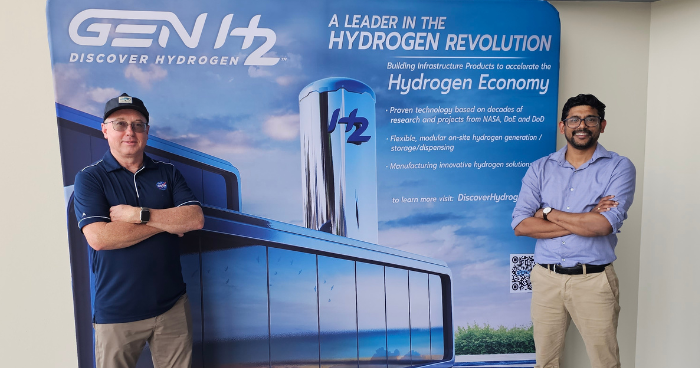 CLT Founding Member James Fesmire and Dr Baduge. (Picture: Supplied)
The team is working on a unique custom-designed cryostat to test hydrogen leaks in stressed conditions to test and validate composite materials for composite vessels. Dr Baduge highlighted that these cryogenic capabilities would enable composite and other material developments for the aerospace industry, including H2-powered aircraft, hypersonic vehicles, rockets and space shuttles.
Expected project outcomes will also enable Australia's sovereign cryogenic capabilities required for particle and nuclear physics and fusion, quantum computing, superconductivity, and the aerospace industry.
“This project would not be possible without the University and our research office’s support. I feel very grateful that we share the same understanding of the strategic importance of LH2 research,” Dr Baduge said.
Dr Baduge was awarded a prestigious Sir Winston Churchill Fellowship in 2023 to focus on "Design and Construction of Next-Generation Hydrogen Storage Infrastructure." This Fellowship will support his study of cryogenic testing, new technologies and materials to store hydrogen economically and safely.
“The testing and research performed with the cryostat will lay the groundwork for future collaboration between the University and GenH2 to further the development of large-scale liquid hydrogen infrastructure, supported by ARENA’s funding,” he said.
“This research will contribute to Australia's National Hydrogen Strategy, which aims to leverage the country's energy resources for the hydrogen economy to decarbonise our energy market, strengthen the economy and create new jobs through energy exports.”
Find out more about the ARENA project here: https://eng.unimelb.edu.au/ingenium/infrastructure/researchers-begin-path-to-mega-scale-liquid-hydrogen-storage/