ARC Linkage Project funds six projects with FEIT researchers
Six projects involving FEIT researchers have received funding through the Australian Research Council (ARC) Linkage Projects 2025 Round 2. Four of the projects were led by FEIT, securing $1.98 million of the $99.8 million awarded nationally this round.
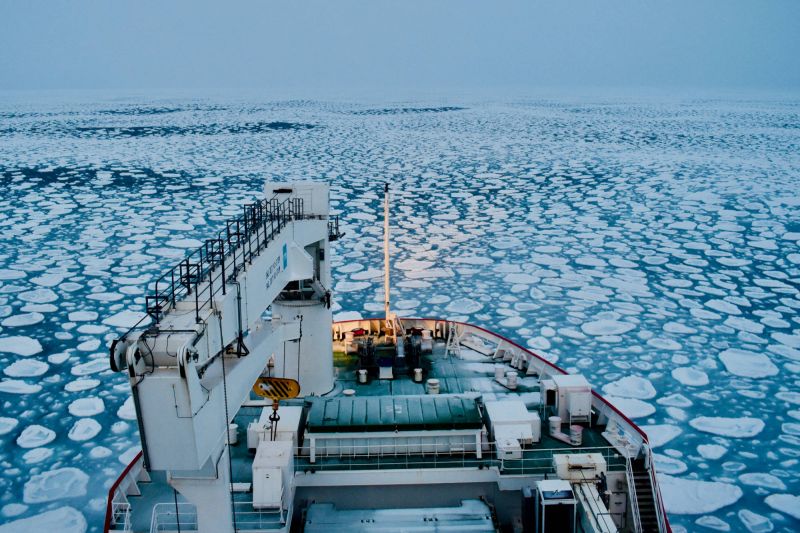
Icebreaker vessel.
The projects span energy, environment, health and infrastructure, developed in partnership with industry, government or community organisations.
Announcing the grants, ARC Chief Executive Officer Professor Ute Roessner said the investment reflects the important role of collaboration in turning research expertise into practical benefits.
“Strong partnerships are essential to ensuring Australian research delivers benefits to industry and the community,” Professor Roessner said.
“These projects bring together diverse expertise to address challenges that matter – supporting healthier communities, more sustainable industries and innovative approaches to complex national issues.”
Cement production accounts for around 8% of the global CO2 emissions but is used in concrete for essential modern infrastructure. Professor Priyan Mendis (Department of Infrastructure Engineering), Dr Anuradha Silva (Department of Infrastructure Engineering) and Professor Gianluca Ranzi (University of Sydney) are developing a new form of concrete that contains no cement and is carbon negative. Built from materials widely available in Australia and designed for mass production, this technology has the potential to fundamentally transform the construction industry’s environmental impact. This will be done in collaboration with industry partner Mr Michael Feldman from North Western Processing in Avoca.
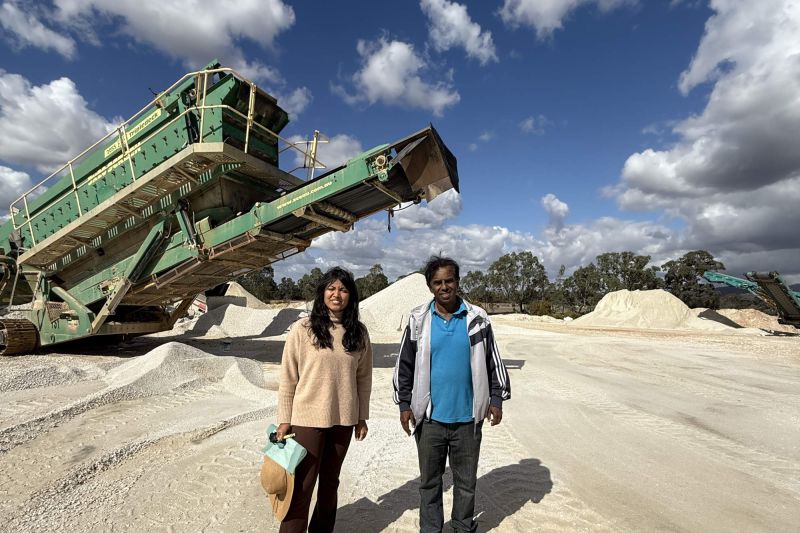
From left: Dr Anuradha Silva and Professor Priyan Mendis.
Safe navigation through Antarctic waters depends on accurate, up-to-date information about sea ice, but current satellite data alone can’t capture the full picture. Professor Alessandro Toffoli (Department of Infrastructure Engineering) along with a large, interdisciplinary team is developing new image analysis methods that draw on a large collection of photos from both satellites and Australia’s Antarctic ship, the RSV Nuyina. In partnership with the Australian Antarctic Division and the Korea Polar Research Institute, this project will create accurate and user-friendly sea ice maps to support safe and efficient navigation for icebreaker crews and improve the efficiency of scientific missions and operations in the region.
When crises strike, access to power is critical. With their team, Associate Professor James Bullock and Deputy Dean, Research Professor Stan Skafidas (Department of Electrical and Electronic Engineering) are developing new power converters that can rapidly establish electricity in emergency situations and power remote devices in motion. This work builds on their partner PELOS’ laser power beaming system and could allow emergency teams to deploy flexibly, reconfigurable power where it’s needed. Beyond emergency response, the technology presents significant opportunities in national resilience and global exports.
Accurately measuring joint motion currently requires expensive medical imaging equipment and specialist expertise, limiting its use to specific labs. Professor David Ackland (Biomedical Engineering), Professor Richard Sinnott (School of Computing and Information Systems), Professor Saman Halgamuge (Department of Mechanical Engineering) and Dr Hans Gray (Department of Biomedical Engineering) are developing a low-radiation form of X-ray imaging system combined with data-driven modelling to create an accessible, easy-to-use toolkit for assessing joint motion. In partnership with MAXONIQ, it’s designed to be used by non-specialists at scale. The toolkit will be introduced to industry and hospital personnel through seminars, demonstrated to government authorities through workshops, and promoted more widely through social media.
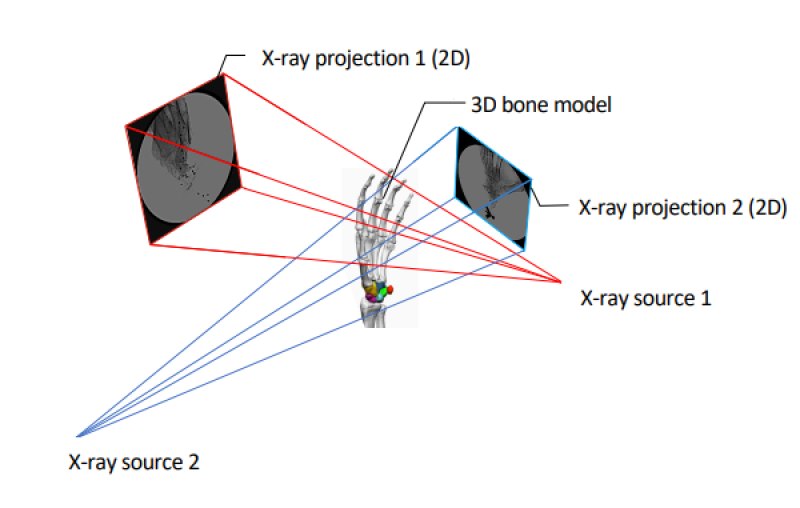
High precision 3D joint motion is calculated by combining dual-plane video X-ray images with 3D computational modelling and next-generation data analytics.
Led by the Faculty of Science, Professor Paul Mulvaney (School of Chemistry, Faculty of Science) and Associate Professor James Bullock (Department of Electrical and Electronic Engineering, FEIT) in partnership with Clearvue are developing windows which can function as solar panels, generating power while still remaining transparent in buildings. If used at scale, this technology could reduce energy consumption and greenhouse gas emissions across city skyscrapers, homes, factories and agricultural greenhouses.
Air pollution is linked to over 3000 deaths nationally per year, with an estimated cost of more than $6 billion. Professor Kenneth Crozier (School of Physics, Faculty of Science, and Department of Electrical and Electronic Engineering, FEIT) will develop a compact and affordable device, named a mid-infared microspectrometer, capable of detecting and measuring air pollution in buildings. With partner Empowered Startup, it will be integrated into a powered, wearable air purifying respirator, allowing users to both filter and monitor the air they breathe in real time.