ARENA grants light the way to ultra low-cost solar power
Two teams of researchers and industry partners, led by the University of Melbourne, will draw on robotics, machine learning, pioneering design, new materials for light capture and other technologies to increase the energy capturing capacity of solar panels.
Announced on 31 August, the two, five-year research projects will each be funded by $4.8m grants from the Australian Renewable Energy Agency (ARENA).
The projects are amongst 20 national projects receiving a total of $105.6m that aim to open the frontier to ultra low-cost solar power. They seek to reduce the cost of designing, building and operating large-scale solar farms by addressing some of the biggest challenges facing the sector.
ARENA has set a goal of reducing the installed cost of large-scale solar to 30 cents per watt by 2030. This is expected to substantially reduce the cost of solar-generated electricity, from the current $50–80/MWh to at or below $20/MWh.
Professor Rebecca Yang, Doreen Thomas Fellow in the Faculty of Engineering and Information Technology’s (FEIT’s) Department of Infrastructure Engineering, will lead the project “Intelligent modular platform for solar PV” (totalling $12.9m).
Her team will seek to improve the cost and efficiency of large-scale solar farms using prefabricated designs that include all the necessary components, hardware and infrastructure, and will draw on robotics, AI-enabled automation tools and energy management systems.
Associate Professor James Bullock, from FEIT’s Department of Electrical and Electronic Engineering, will lead the project “Spectral utilisation for next-gen silicon” (totalling $13.2m).
His team will develop a series of spectral technologies, relying on novel materials, which, when integrated with state-of-the-art silicon solar cells, could improve module efficiencies and longevity.

Professor Rebecca Yang and Associate Professor James Bullock.
Intelligent solar panels for ultra low-cost power
The project “Intelligent modular platform for solar PV” seeks to provide evidence for a pathway to solar electricity at or below $20 per megawatt-hour. Researchers will work with WSU, CSIRO, UGL, ARI Energy, SunPower, Katana Foundations and more.
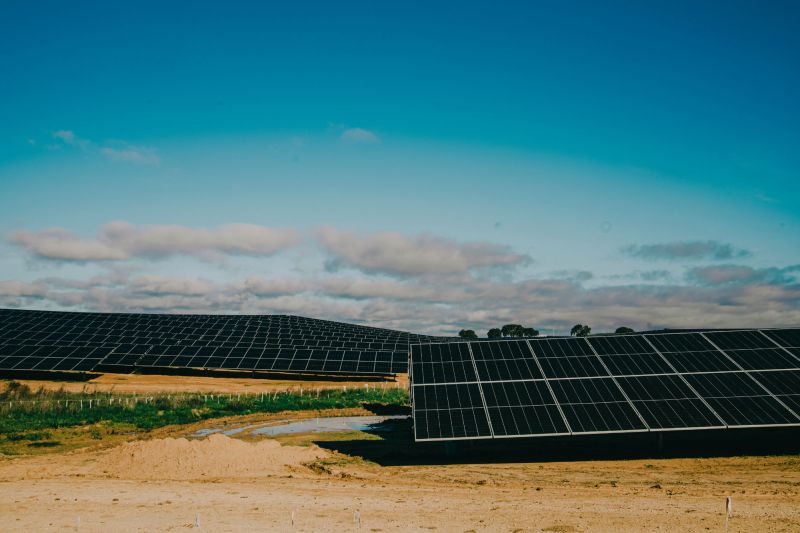
Utility-scale solar farms, which are very large power plants that send electricity straight to the public power grid, need to be built faster and cheaper if Australia is to reach ultra low-cost solar. This scale typically occupies thousands of acres. The team will develop modular, automation-ready solar farm systems to reduce construction and operating costs.
Current projects can involve high costs, labour-intensive installation and complex long-term operations, which can increase costs, slow deployment and make it harder to reduce the cost of solar electricity.
The team will move from design and laboratory testing to pilot deployments and multi-site demonstrations to validate productivity, safety, performance and cost savings.
“We hope to deliver validated modular designs, automation tools, energy management systems, cost models and deployment guidance that can be used by our industry partners,” Professor Yang said.
Professor Yang is the Chair and board member of the Australian PV Institute, and the Executive Committee Member representing Australia in the International Energy Agency Photovoltaic Power Systems Program.
Better spectral management for next-generation solar panels
In the project “Spectral utilisation for next-gen silicon,” the team will seek to improve solar panels by using spectral technologies to boost efficiency and stability – helping silicon solar panels to capture more energy from light, run cooler, and last longer. Silicon solar cells, which convert sunlight into electricity, are the main active component of a solar panel.
New spectral management technologies, such as downshifters and downconverters, can help devices use the electromagnetic spectrum more efficiently. They could help solar modules capture more useful light, operate at lower temperatures and last longer. However, they need to be proven in larger prototypes and tested under real world conditions.
Associate Professor Bullock explained that sunlight is made of many colours (wavelengths) – from ultraviolet, through visible to infrared.
“Some sunlight is not used as effectively as it could be, and heat and ultraviolet exposure can reduce module lifetime. The spectral technologies we are developing target these problems,” he said.
The team will work with researchers from Monash University, Adelaide University, University of New South Wales, Jinko Solar, King Abdullah University of Science and Technology, and University of Bayreuth.
Sustainable resources | Energy | Staff awards and achievements
More Information
Professor Rebecca Yang, Associate Professor James Bullock