Break-away ice buoys reveal changes in Antarctic sea ice
Waves generated inside areas of open water amid Antarctic sea ice can become energetic enough to break up sea ice from the inside out.
FEIT researchers Dr Joey Voermans and Professor Alexander Babanin from the Department of Infrastructure Engineering, together with Dr Petra Heil from the British Antarctic Survey and other collaborators, have studied the impact of these waves.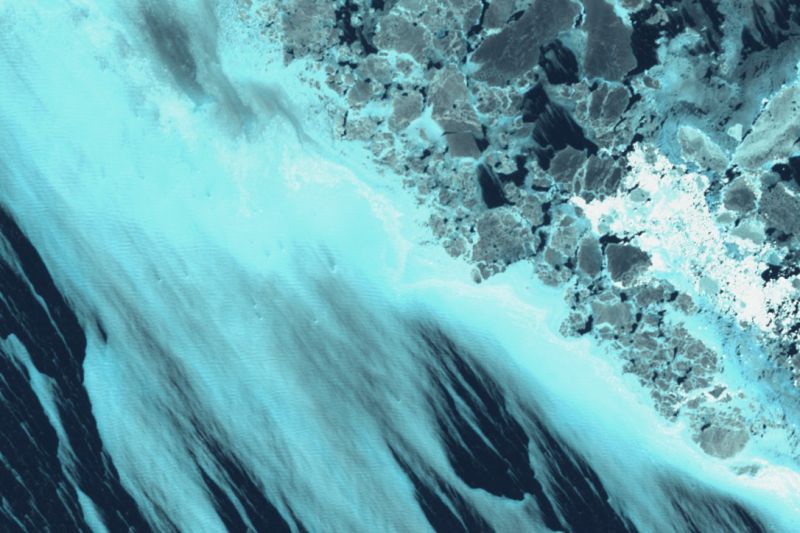
Waves visible from space: an enhanced-colour satellite image showing waves generated within the polynya propagating into the broken sea ice. Contains modified Copernicus Sentinel data 2025, processed in Copernicus Browser.
When we picture Antarctica, we see a vast frozen expanse populated by penguins and the occasional research station. But within this pristine panorama lie recurring and persistent areas of open water, known as ‘polynyas’. And it turns out these stretches of water, surrounded by vast Antarctic sea-ice, play an important role in how sea ice forms and changes.
Waves rising amid the ice
For many years, we’ve used ice buoys to measure waves arriving from the Southern Ocean and their propagation into the sea-ice pack. These energetic waves can break up the outer sea-ice cover, but progressively weaken as they travel farther into the ice.
We had deployed these buoys on coastal landfast ice bordering the Vincennes Bay Polynya, near Casey Station in East Antarctica. On several occasions, the fast ice beneath our instruments broke away from the coast, sending the buoys drifting across the polynya.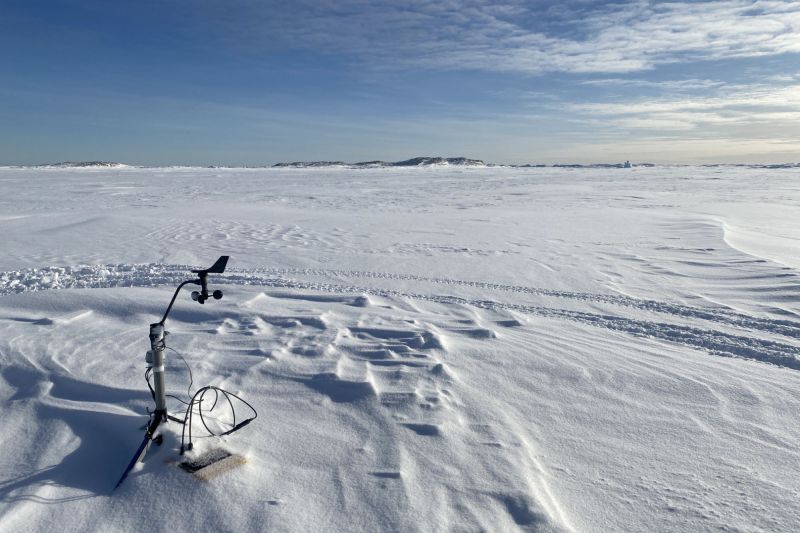
An ice buoy deployed on Antarctic sea ice near Casey Station. AAD.
As they entered the open water they recorded a rapid increase in wave energy.
This increase can be explained by a simple concept known as fetch. Wind needs open water to generate and grow waves. The greater the distance over which the wind blows across open water – the fetch – the more opportunity waves have to grow.
In the Vincennes Bay Polynya, the fetch can extend for tens of kilometres during strong winds, enabling substantial waves to develop within an otherwise ice-covered region.
Our break-away buoys measured relatively short, steep waves generated locally by strong winds, rather than the longer-period swell arriving from distant storms in the Southern Ocean.
Working with Australian and international collaborators, we combined these buoy measurements with satellite observations, weather data and numerical wave modelling to understand how the waves developed and what happened to the surrounding sea ice during the strongest events.
Our study, published in Nature Communications, shows that during the most extreme wind events, waves generated within a coastal polynya can become steep enough to fracture the surrounding sea ice from the inside out, transforming the sea-ice conditions in and around the polynya.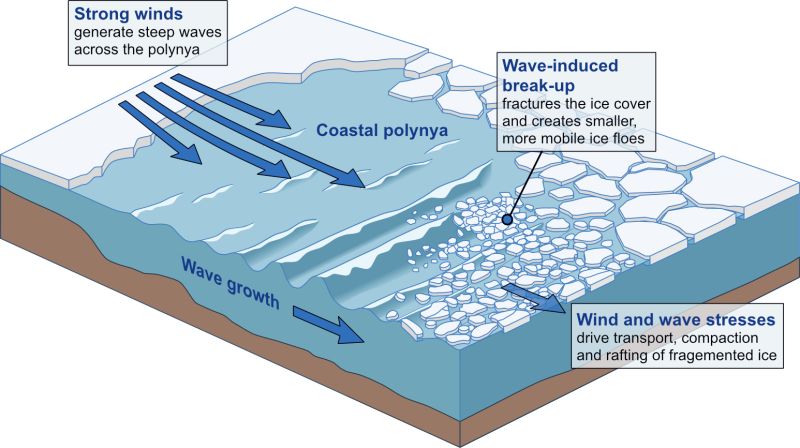
A conceptual illustration of inside-outward sea-ice breakup, where energetic waves develop across the polynya under strong winds and reshape the surrounding sea-ice cover. Dr Joey Voermans.
Breaking and redistributing the ice
Fracture is only the first stage of the response. A relatively connected ice cover becomes fragmented into smaller, more mobile floes. The wind continues to act on this broken ice, while the waves themselves transfer momentum as they enter the ice cover. Together, these forces can transport and compact the fragmented ice downwind, with individual floes even rafting over one another.
We found evidence of this larger-scale response in more than two decades of satellite observations. Following the most extreme wind-wave events, sea-ice concentration around the polynya decreased by up to about 30 per cent, with the changes persisting for at least a week. Farther downwind, ice concentration increased.
This suggests the ice was not simply disappearing. Instead, our observations are consistent with wave-induced break-up making the ice more mobile, followed by wind- and wave-driven redistribution of the fragments.
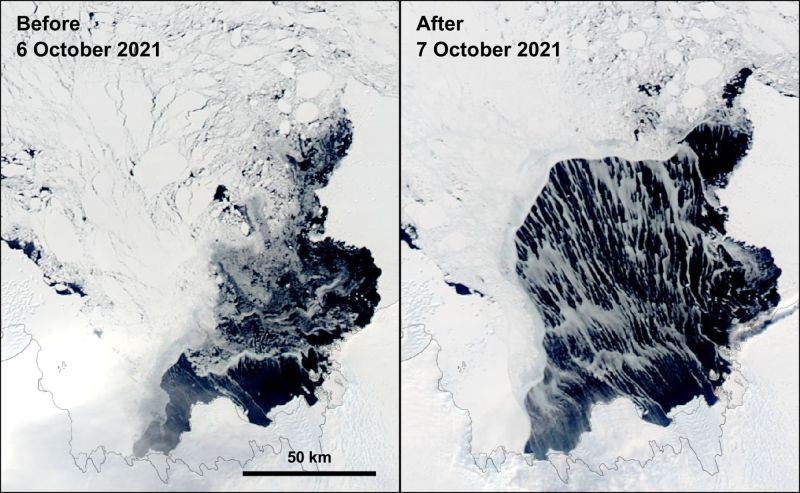
Satellite images showing the rapid opening of the Vincennes Bay Polynya between 6 and 7 October 2021, during an event captured by one of our drifting wave buoys. NASA Worldview.
The reduction in sea-ice concentration also increases the area of open water exposed to the cold atmosphere, providing more space for new sea ice to form, considerably increasing net ice production. Satellite observations support this picture, showing a clear increase in areas of actively forming frazil ice following the extreme events.
In other words, locally generated waves can do more than break individual pieces of ice: they can alter the state and evolution of the polynya itself.
The bigger polynya picture
Until now, waves have received relatively little attention in our understanding of Antarctic coastal polynyas. Our observations suggest they should be part of that picture.
This doesn't mean waves are constantly breaking up the edges of coastal polynyas. However, when strong winds coincide with sufficient open-water fetch, locally generated waves can break up and redistribute the surrounding sea ice.
Vincennes Bay is unlikely to be the only place where conditions allow locally generated waves to grow and affect the surrounding sea ice. Strong winds are a defining feature of many Antarctic coastal polynyas, and many have comparable or larger stretches of open water over which waves can develop.
The question now is how important these waves are across different coastal polynyas, and which combinations of wind, fetch and sea-ice conditions produce the greatest impact.
This issue becomes increasingly relevant as Antarctic coastal polynyas change. Previous research indicates that they have increased in size over recent decades. Larger areas of open water provide greater fetch, giving locally generated waves more room to develop.
Polynyas are important parts of the Antarctic climate system, driving intense exchange between the ocean and atmosphere, producing sea ice, and in some regions contributing to the dense-water formation that feeds global ocean circulation. Understanding how they evolve in a changing climate therefore means accounting for the waves generated within them.