Dr Helena Wang and Associate Professor Milad Haghani named Young Tall Poppies
Dr Helena Wang, from the Department of Chemical Engineering, and Associate Professor Milad Haghani, from the Department of Infrastructure Engineering, have been named 2026 Victorian Young Tall Poppies by the Australian Institute of Policy and Science (AIPS).
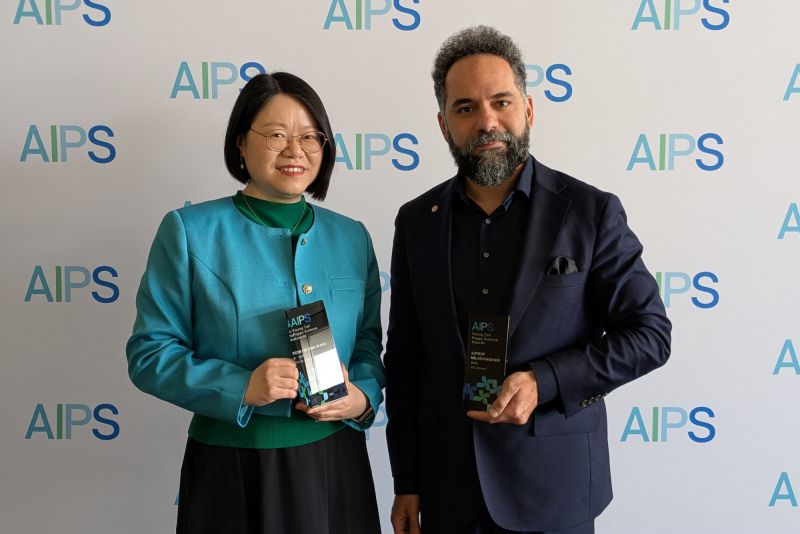 Dr Helena Wang and Associate Professor Milad Haghani
The Young Tall Poppy Science Awards recognise outstanding early-career researchers who demonstrate excellence in scientific research and communication, together with a strong commitment to engaging and inspiring the broader community through science.
Dr Wang's research addresses a growing sustainability challenge: how valuable and critical resources can be recovered from increasingly complex waste streams and returned to productive use.
Her work focuses on developing innovative recycling and resource recovery technologies for waste materials, including spent lithium-ion batteries, end-of-life photovoltaic panels and other electronic waste. By developing more efficient and sustainable approaches to separate, recover and regenerate critical materials, her research aims to reduce waste, retain the value of finite resources and support a more circular economy.
“As our transition to clean energy accelerates, we also need to consider what happens to these technologies at the end of their life," she said.
"Waste should not simply be viewed as something to dispose of, but as an important source of critical resources that can be recovered and used again.”
Beyond her research, Dr Wang is passionate about communicating science and engineering to broader audiences and inspiring the next generation to engage with sustainability challenges.
“I am honoured to receive this recognition. For me, research impact is not only about developing new technologies, but also about communicating why they matter and connecting research with the people and communities it can benefit,” she said.
Associate Professor Haghani was recognised for his unique contributions to generating and disseminating the science of urban mobility and safety and, in doing so, informing best practice and policy across Australia and globally.
A frequent contributor to ‘The Conversation,’ he's used his research to advocate for policy changes that improve road safety and other issues, and has written on the science behind disasters, reaching a readership of more than two million people.
He has been a leading public voice on matters such as free public transport and electric micro-mobility, where his research has frequently informed policy and parliamentary inquiries. He regularly engages with news media to explain the rationale and implications of policy to the public.
"When there is an evidence vacuum, my research tends to address it," he said.
"Through my public outreach, I then endeavour to bring those urban safety and security issues to the surface and into national debate."
Through these extensive efforts to bring academic knowledge into the public domain, Associate Professor Haghani has helped make urban safety science broadly accessible, helping communities to become better informed and ultimately safer.
As Victorian Young Tall Poppies, Dr Wang and Associate Professor Haghani will join a national network of emerging research leaders and contribute to science outreach and engagement activities with schools and the wider community.