Melbourne team ‘taking energy from thin air’ named ‘Net Zero Tech’ champions
Pioneering technology that takes “Energy from Thin Air” has led to a championship prize for a team of Melbourne chemical and mechanical engineering PhD students.
The team from the University of Melbourne’s Faculty of Engineering and Information Technology, along with an RMIT University PhD student, have been named champions in the Sustainability Category of the “2026 Net Zero Tech International Contest.”
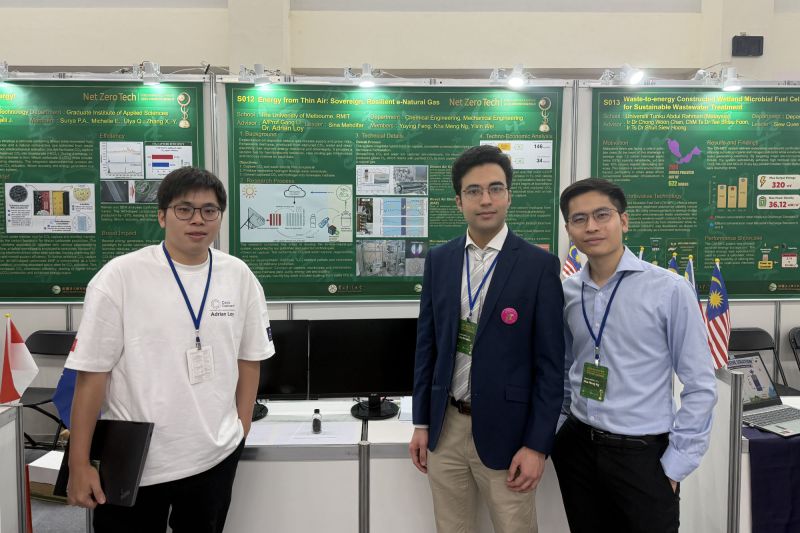
From left: Dr Adrian Chun Minh Loy, Sina Mehdifar and Kha Meng Ng.
They were competing against 147 teams from around the world at the event, hosted by National Taiwan University in Taipei.
The winning project, “Energy from Thin Air: Sovereign, Resilient e-Natural Gas,” demonstrated a pathway for producing renewable e-natural gas using carbon dioxide captured directly from the air. The technology then combines this gas with renewable hydrogen to produce safe, affordable, low carbon natural gas.
Team advisor Associate Professor Gang Kevin Li said the technology has been designed to support the net-zero transition, making use of existing gas infrastructure and strengthening domestic energy resilience in Australia.
“It was an ideal opportunity to showcase the groundbreaking work the team is undertaking to assist the transition to net zero,” Associate Professor Li said.
“Our sincere thanks to National Taiwan University and the TECO Technology Foundation for organising this international platform for young researchers to develop practical solutions for the net-zero transition. Many thanks also to Fubon Financial Holding Co Ltd for the generosity in providing the grand prize.”
The students worked with the University of Melbourne spin-off Thin Air Technology Pty Ltd, co-founded by Associate Professor Li. The company was the team’s core technology and commercialisation collaborator and is leading the translation of this research towards commercial deployment through technology scale-up and larger-scale demonstrations.
Thin Air, Associate Professor Li and the team have secured over $3m investment from the Genesis Pre Seed Fund and other partners and attracted multiple grants from Australia’s Economic Accelerator Ignite program.
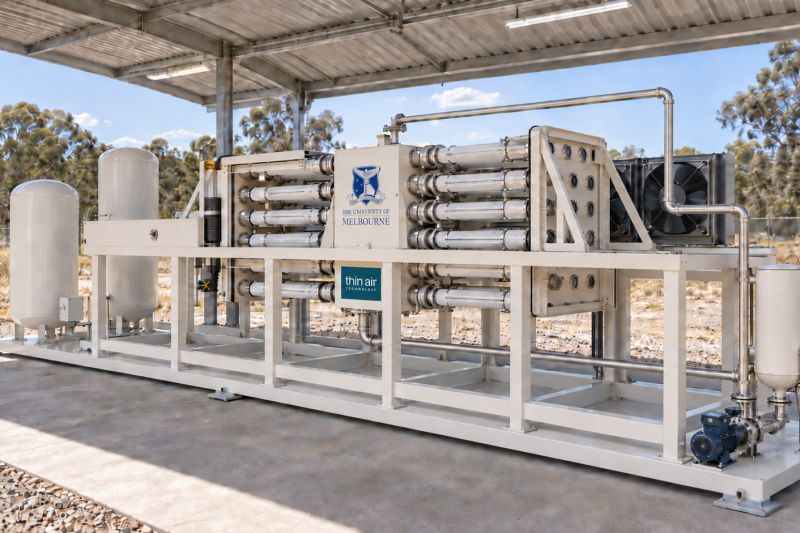
Direct Air Capture rig, with new modular moving bed design, funded by Australia’s Economic Accelerator Ignite, Federal Department of Education.
The team is presently commissioning a 10 kW pilot-scale direct air CO2 capture facility with a new modular, moving-bed design and a 2kW microwave reactor for green methane production.
“This means the first end-to-end demonstration of air-to-fuel is on its way to Australia,” Associate Professor Li said.
The team included: advisor Associate Professor Li, co-advisor Dr Adrian Chun Minh Loy, graduate researchers Yixin Wei and Mary Yuying Feng, all from the Department of Chemical Engineering; Kha Meng Ng from the Department of Mechanical Engineering; and chemical engineering PhD student Sina Mehdifar from RMIT University.
The competition was organised by the non-profit TECO Technology Foundation, established by Taiwan's TECO Group (TECO Electric and Machinery) to promote science, education and cultural development, and National Taiwan University, with over 20 co-organisers and sponsors.
The contest is open to undergraduate and graduate students and aims to cultivate talent, enhance industry-academia collaboration, promote global exchanges in net zero technologies, and improve the dissemination of net zero knowledge. It drew 267 teams and 1,144 participants from 79 universities across 20 countries.