Engineers keep cool on jet engines, thanks to Frontier supercomputer
University of Melbourne researchers are working on the world’s first exascale supercomputer to improve the fuel efficiency and performance of some of the world’s most sophisticated jet engines.
Working for several years now with the global leader in turbine manufacturing, General Electric (GE) Aerospace, the team has pioneered a simulation model for use on the supercomputer, Frontier, in the United States. GE Aerospace is one of the world’s leading jet engine manufacturers, with an installed base of approximately 45,000 commercial and 25,000 military aircraft engines.

An aircraft engine. Credit: Jaromír Chalabala/Adobe Stock
Led by Professor Richard Sandberg, Chair of Computational Mechanics in the University’s Department of Mechanical Engineering, the group’s methodology is being used to simulate several important factors affecting engine performance. They aim to shave millions of dollars and months off development cycles, and improve durability, performance and fuel efficiency of new jet engines.
“It is enormously expensive and almost impossible to do this research on real jet engines in the laboratory, so our approach is helping achieve a step-change in knowledge about jet engine flow physics,” Professor Sandberg said.
The team is conducting world-first simulations to understand the fundamental physics of the cooling system in jet engines, which operates like a showerhead, where many small jets of cool air flow out of the blade surface and form a cushion layer of cold air that protects the blades from the hot gas coming from the combustion chamber.
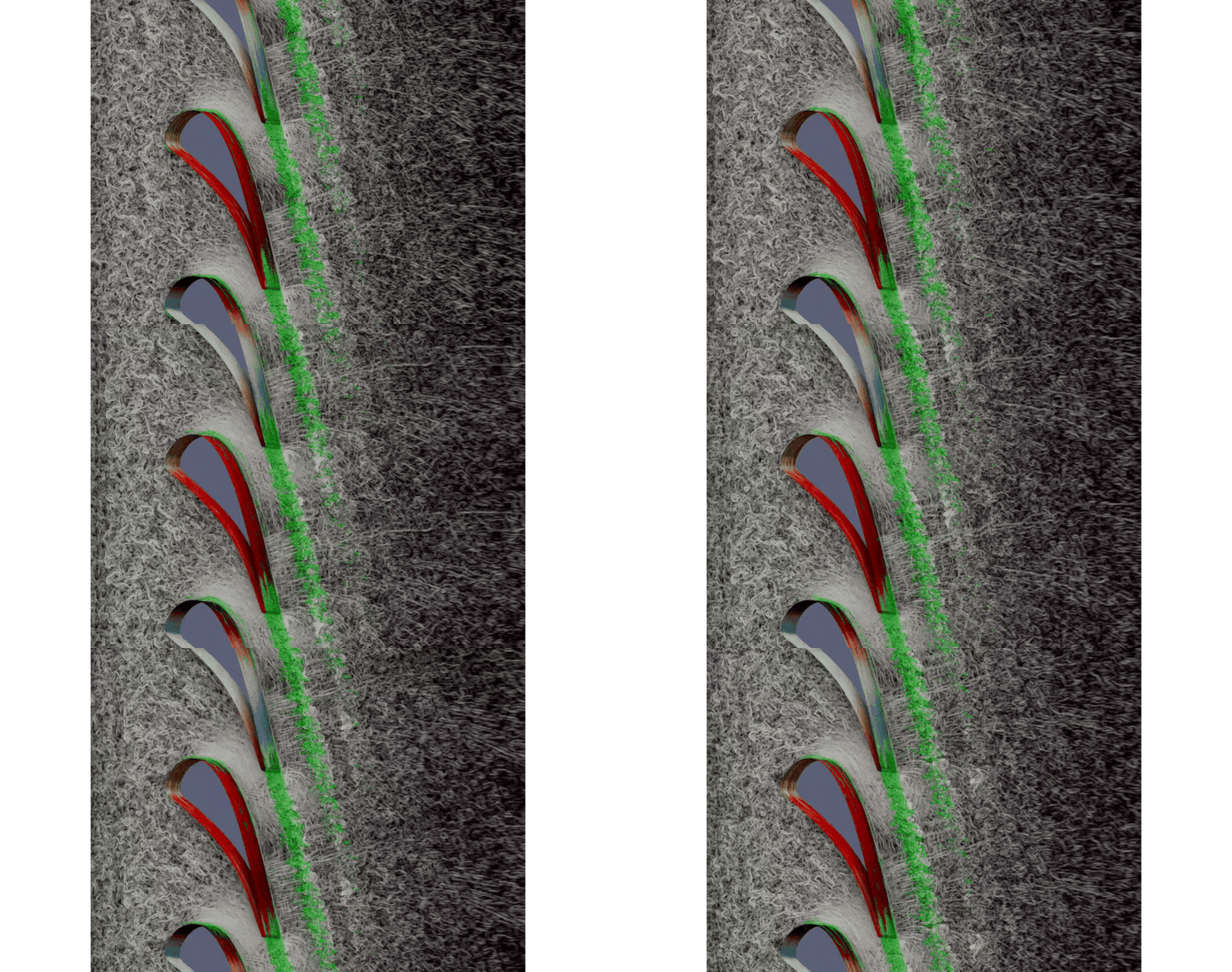 World-first simulations have been able to ‘see’ inside the jet engine, examining the incredibly complex air flows around its individual blades. Credit: Dr Tom Jelly, University of Melbourne
Researcher Dr Tom Jelly said the blades of a high-pressure turbine in modern jet engines operate at temperatures hundreds of degrees above their melting temperature.
“One reason they survive this intense heat is due to sophisticated cooling schemes,” Dr Jelly said. “This cooling is particularly important in fighter jets, like the F35. The maximum temperature inside the engine is almost 2000°C.”
Most commercial aeroplanes are powered by two engines, which are up to four metres long and weigh around 8000kg and can be worth almost $100 million per aeroplane. The global cumulative cost of jet fuel in 2025 is projected to be $248 billion, therefore even a one per cent increase in efficiency represents billions of dollars.
The team has also accurately represented on Frontier roughened surfaces that occur on jet engine blades, which will allow engine designers to improve efficiency.
Dr Jelly said the blades of a high-pressure turbine directly face the combustion chamber and are subject to the highest temperatures and fastest air flows in the entire engine.
“Although the roughness on the blades is fine-scaled, it significantly changes the performance of the blade, which, in turn, increases how much jet fuel the aeroplane needs to fly. These learnings about fuel use as engine blades become rougher can be used by GE to improve blade lifespan and engine maintenance planning,” he said.
 Dr Melissa Kozul with a 3D-printed model of a jet engine.
The same methodology has been used in a project led by team researcher Dr Melissa Kozul to represent sharkskin-inspired, micro-scaled engineered surfaces on compressor blades that increase their efficiency, also in collaboration with GE.
“Representing such fine-grained surfaces in realistic jet engine conditions requires huge amounts of computational power,” Dr Kozul said. “Such simulations are only possible through accessing the supercomputer, backed by powerful graphics processing units. We benefited from a collaboration with the Pawsey Supercomputing Centre in Perth to get our code ready for Frontier.”
This research is supported by a computational grant via the INCITE Program by the USA Department of Energy, awarded to University of Melbourne researchers and GE Aerospace.

Illustration of a 3D microscopic engine blade surface riblet - the spacing between the ridges of the riblets is less than the width of a human hair. Credit: Melissa Kozul