Fluid researchers to spearhead 4D measurement device for cleaner energy
Researchers from the University of Melbourne, in collaboration with the University of Adelaide and Monash University, are developing a new measurement system to improve understanding of how fluids like air and water move in complex systems, to help industries such as renewable energy, aerospace and manufacturing transition to a lower-emissions future.
The research is being funded through a $1.76 million investment from the Australian Research Council’s Linkage Infrastructure, Equipment and Facilities scheme, over a one-year period.
Fluid flows are fundamental in many technologies, including engines, aeroplanes, renewable energy systems, such as solar panels and heat exchangers, heat pumps and batteries. A better understanding of these complex flows can help make systems more energy-efficient by reducing fuel use and lowering emissions.
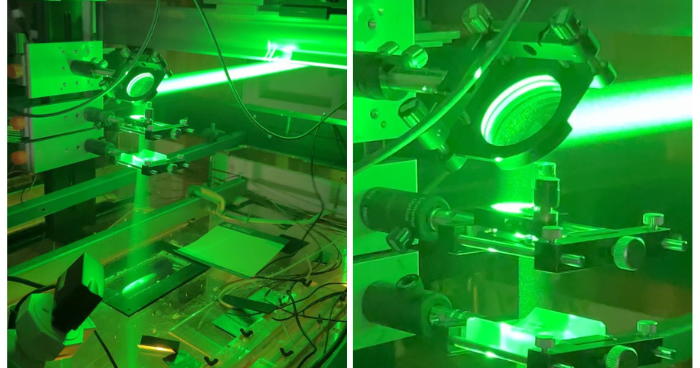
A set-up of the research team's particle image velocimetry, an optical technique used to measure and visualise fluid flow by tracking the motion of small particles. Picture: Supplied
Led by Professor Nicholas Hutchins from the Department of Mechanical Engineering in the Faculty of Engineering and Information Technology (FEIT), the team will develop a 4D velocity, phase and temperature measurement system.
This system will be comprised of two high-speed (high repetition rate) lasers that illuminate at different wavelengths and a collection of six high-speed cameras. These components, combined with advanced software for image processing, will allow researchers to obtain detailed measurements of fluid flows.
“Studying fluid flows, especially when complicated by turbulence, heat transfer or suspended particles, has traditionally been challenging,” Professor Hutchins said.
“This research will not only answer important questions but also support collaboration with industries in need of solutions.”
The measurement system will be highly versatile, supporting diverse research and industry applications to create more sustainable, efficient and low-emission technologies. For example, it will support FEIT researchers in studying aircraft and ship drag, track bat flight for metabolic efficiency insights, integrate with Melbourne’s X-Tunnel facility, and support the University of Adelaide’s De-Risking Decarbonisation for Heavy Industry initiatives.
The project brings together experts in fluid mechanics from multiple institutions, including FEIT’s Professor Jason Monty, Professor Ivan Marusic and Associate Professor Jimmy Philip, and the Faculty of Science’s Dr Shannon Currie.