Highlights from the Semester 2 Endeavour Exhibition
The Semester 2 Endeavour Exhibition showcased FEIT master’s degree student projects, from app developments to improved ultrasounds, and much more! The event was a glimpse into the future of engineering and technology.
Meet some of the participating teams and their projects:
Evaluation and calibration of a markerless motion capture
By Jayan Greenwood, Nguyen Hong Phu Trinh, Ze Kai Cheong and Tuan Khoi Nguyen.
“Our project involved collaboration between CSIRO and The University of Melbourne. We are working on a motion capture project, which is similar to the technology used to create ‘Avatar’ movies, where they attach dots to people. What we're looking at is bringing motion capture, which is really expensive at the moment, to clinical contexts.
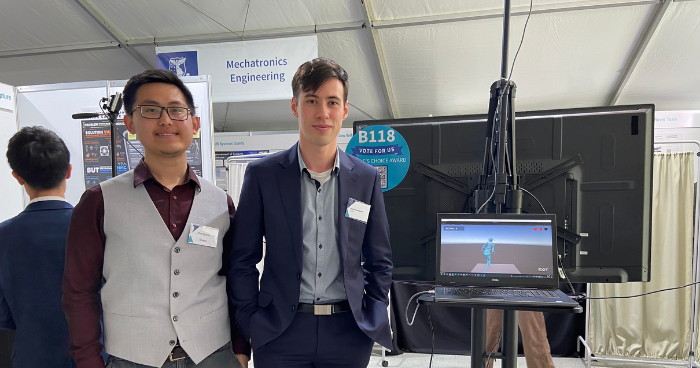 Tuan Khoi Nguyen and Jayan Greenwood.
"So, to consider how to assist people with moving impairments and assist clinicians to develop and assess people, we set up a full human research study, where we examined trials and validated our new system, in comparison to the traditional, extremely expensive system.
"The main issue is that clinicians are presently constrained in making informed decisions about movement. When we went to the Epworth Rehabilitation Centre in Richmond, we saw that they generally had to make do with rulers, protractors and barometers to make their assessments. Our goal is to utilise motion capture technology to help their patients and develop some really good results," said Jayan Greenwood.
Geotechnical engineering platform
By Dimitri Sadikin, Sean Wong, Bin Liang, Haimo Lu, Mohammed (Emaad) Beig, Cheng Chien Li, Zhiyao Wang, Yanxiang Qiao and Yongle Chen.
“Our project relates to offshore geotechnical engineering. Our client wanted us to bring their research to life. So, we created a website utilising their research, alongside the codes that they've worked on themselves.
 Bin Liang, Dimitri Sadikin, Sean Wong and Zhiyao Wang.
"Our website is a graphical interface to calculate different offshore geotechnical engineering problems, which typically revolve around a renewable energy source.
"This engineering field revolves around infrastructure that is built in the sea; in our case, relating to wind turbines that are grounded in the middle of the Atlantic Ocean. This is because the wind is much stronger there than on land. In addition to advocating for their research to be utilised in real-life applications, our client works to promote the use of renewable energy sources.
"One solution we explored related to ground anchors that may eventually reach a breaking point. Using calculations, engineers could create an anchor plate that prevents a breaking point from being reached," said Dimitri Sadikin.
Online software for fast-tracking code-compliant earthquake-resistant design of structures
By Lachlan Siouclis, Antonio Chen and Nicholas Kardis.
“Our project involved online software that helps with earthquake-resistant designs in Malaysia. In essence, it is a ground motion prediction model that will eventually assist engineers in Malaysia to develop project responses that are site-specific.
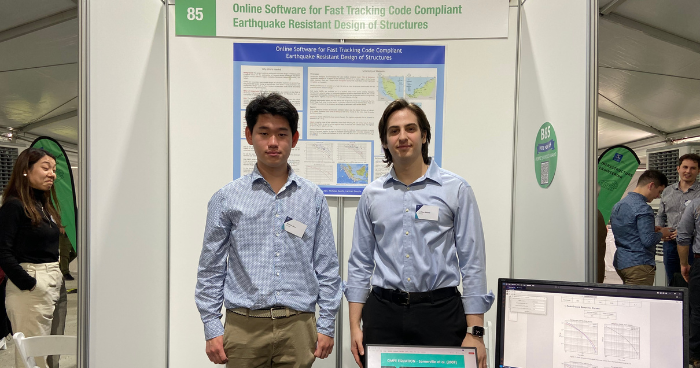 Lachlan Siouclis and Antonio Chen.
"We created a Python program, which allows users to choose between Peninsula Malaysia and Eastern Malaysia. You input a moment magnitude, the ground velocity and the rupture distance, which is the distance between your site and the rupture.
"The ground motion prediction equations, or GMPs, that we selected, based on our literature review, will be integrated into a new program in the future that will allow users to input the data for more detailed information about their site," said Lachlan Siouclis.
Insulin dose calculator app
By Declan Dempsey, Yi-Cheng Peng, Yifan Zhu, Yan-sin Huang, Rengarajan Narayanan and Jeffrey Kengsley
“Our project was about calculating insulin goals. Patient's glucose levels might change, while they are ill in the hospital, or due to their medicine intake. According to scientific research, managing hospital glucose readings well might actually improve health outcomes.
"Therefore, we created this algorithm, in collaboration with a clinician from the Royal Melbourne Hospital, to assist the clinician in determining the appropriate insulin dose for a patient, based on data," said Yi-Cheng Peng.
Yan-sin Huang explained that "The clinician or app retrieves the data from the medical record system for the patients for whom they wish to calculate the insulin index. They enter the data into our system and, depending on the glucose reading or the status of hyperglycemia, the clinician can update the data, add more glucose readings or add more insulin doses. The result informs the clinician whether to change the insulin dose, start a new type of insulin or keep using the current one."
"The target users of the app are clinicians and other medical professionals because medical records are carefully protected due to their sensitive nature. So, in order to make this work inside the hospital, it needs two more years to deploy," said Yi-Cheng Peng.
"The first step in translating this is to communicate the benefits of the app with the EMR provider and provide evidence that the app is secure," noted Yan-sin Huang.
Yi-Cheng Peng also shared that the team was unaware that "Over one-third of hospital inpatients require a specific level of glucose control, making glucose management a significant problem in the hospital setting." This project provided the student team with an opportunity to address this issue and to find a solution.
Following the Endeavour Exhibition, the Awards Night recognised the hard work of our students and celebrated their projects. Winning projects were recognised with department awards, industry-sponsored awards and the People's Choice Award.