New optical screen could pave way for cheaper infrared cameras
Researchers have developed a new optical screen that converts invisible infrared light into visible light – offering a potential alternative to the expensive detectors used in today's infrared cameras.
New research, led by the University of Melbourne node of the ARC Centre of Excellence for Transformative Meta-Optical Systems (TMOS), demonstrates a new way to make invisible infrared light visible.
Infrared is a type of light our eyes can't see, while carrying information about heat and objects in the environment. It's widely used for environmental monitoring, industrial inspection, medicine and security. However, technologies such as infrared cameras remain expensive because they rely on specialised detectors that are costly to manufacture and often require cooling.
The international team of researchers demonstrated a new way to see infrared light that could one day make these systems smaller, lighter and far less expensive. TMOS Deputy Director and coauthor Professor Kenneth Crozier, Professor of Electronic Engineering and Physics at the University of Melbourne, says the biggest challenge was that making the image brighter often made it blurrier.

From left: Dr Nima Sefidmooye Azar and Professor Kenneth Crozier.
Unlike previous approaches, the new design makes the image brighter while keeping it sharp – two goals that have traditionally been difficult to achieve at the same time.
“The amount of brightening would change depending on the angle the light arrived from, causing fine details to disappear,” Professor Crozier said.
The team overcame this by designing a new type of metasurface – a ‘flat-band’ dielectric metasurface – that works consistently even when light arrives from different angles.
Lead author and TMOS researcher Dr Nima Sefidmooye Azar, who completed the work while at the University of Melbourne and is now based at the University of Queensland, said the optical screen or 'metasurface' the team designed is covered in tiny structures thousands of times smaller than the width of a human hair.
The screen works by controlling how light behaves, concentrating invisible, infrared light where it is needed to make the image brighter.
“Infrared imaging has enormous potential, but today's cameras generally depend on expensive semiconductor detectors,” Dr Azar said. “Our platform offers a completely different approach by converting infrared images into visible ones using a compact optical screen.”
How they did it
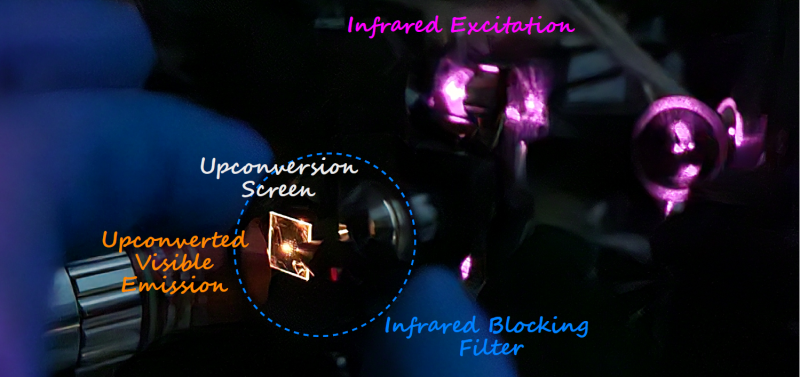
The researchers coated the patterned surface with tiny particles made of rare-earth materials. These particles absorb infrared light and re-emit it as visible light. The metasurface was engineered to trap and concentrate incoming infrared light, dramatically strengthening the interaction between light and the nanoparticles.
The approach made the converted images more than 1000 times brighter than nanoparticles could achieve on their own.
The final picture
The team successfully demonstrated high-resolution, infrared-to-visible imaging, producing bright, high-contrast visible images from infrared patterns while retaining fine spatial detail.
While the current prototype requires active infrared illumination, continued advances in nanoparticle materials and metasurface engineering could dramatically reduce the amount of infrared light needed, bringing practical applications closer.
As the device is compatible with scalable manufacturing methods such as nanoimprint lithography, Dr Azar said it could eventually enable large-area, low-cost infrared imaging devices.
“Our platform combines strong up-conversion enhancement, angular robustness and polarisation independence in a single compact device,” he said.
“The approach offers a pathway toward lightweight and detector-free infrared imaging technologies.”
While more development is needed before the technology reaches commercial products, the researchers believe it could eventually be applied broadly.
“Potential applications include night vision, remote sensing, biomedical imaging and compact infrared cameras compatible with standard visible imaging technologies,” Dr Azar said.
This research was published in the journal ‘Light: Science and Applications’. It was supported by the Defense Advanced Research Projects Agency (DARPA, USA), the Australian Research Council, the US Department of Energy, and the National Science Foundation (USA).
Metasurface fabrication was performed in part at the Melbourne Centre for Nanofabrication (MCN) in the Victorian Node of the Australian National Fabrication Facility (ANFF).