‘Rebel Girls’ highlights inspiring stories of women in STEM
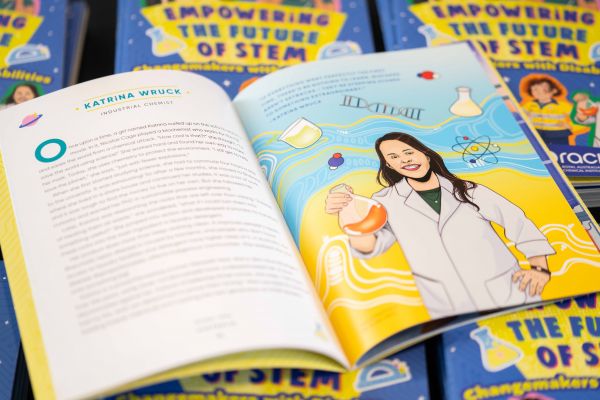
The inspiring story of former University of Melbourne Research Fellow Dr Katrina Wruck is one of those featured in the new 'Rebel Girls' book.
Australian children with disabilities will be inspired by stories of women with disabilities working in STEM fields, thanks to a new ‘Rebel Girls’ program.
‘Rebel Girls’ is a global brand known for celebrating and empowering young audiences through storytelling. It has collaborated with the Royal Australian Chemical Institute (RACI), supported by the University’s Faculty of Engineering and Information Technology (FEIT), to inspire young Australians, especially those with disabilities, to “see themselves in STEM and dream without limits”.
The project centrepiece is a book that is being made available to 12,000 Australian schools, which is being publicised by the Departments of Education, and Industry, Science and Resources.
Head of the FEIT School of Chemical and Biomedical Engineering, Professor Amanda Ellis, who is RACI President, said it was crucial to showcase representation in educational resources.
“Children with disabilities deserve to see role models who reflect their lived experiences. This is just one of the barriers we want to break down for women, especially when pursuing a career in STEM”, Professor Ellis said.
“It’s wonderful that the University of Melbourne can come together with RACI to support this impactful storytelling.”
Among the featured stories is that of Dr Katrina Wruck, a former University of Melbourne Research Fellow, who is based at Queensland University of Technology and is neurodivergent. A proud Mabuygillayg woman, Dr Wruck was awarded the ‘2025 Young Australian of the Year Award’, in recognition of her work in green chemistry and her research giving back to remote communities.
“If everything went perfectly the first time, there’d be nothing to learn,” Dr Wruck says in the book.
“Mistakes aren’t setbacks – they’re stepping stones to something extraordinary.
FEIT provided $20,000 sponsorship for the initiative, equally split across the School of Chemical and Biomedical Engineering and FEIT’s Diversity and Inclusion Grant Scheme.
The initiative will also include a range of classroom resources designed to spark discussion, creativity and curiosity in students.
A copy of the free e-book is available for download.