Researchers discover spiralling flow provides sperm with extra boost
A team of University of Melbourne and Monash University engineers has discovered that swimming sperm create swirling fluid vortices – shaped like rolling corkscrews – giving them an extra boost in the race to the egg.
Published in ‘Cell Reports Physical Science’, the study reveals that these vortices attach to the sperm cell and rotate in sync, adding extra spin that enhances propulsion and helps keep them on a direct path through the fluid.
 Exploded schematic of the reconstructed vorticity field, indicating that superhelix vortex pairs act as corkscrew pairs.
Picture: Supplied
The project involved collaboration between the University of Melbourne Fluid Mechanics Group, led by Redmond Barry Distinguished Professor Ivan Marusic, first author Dr Farzan Akbaridoust (Hon, University of Melbourne Department of Mechanical Engineering) and Monash University Applied Microfluidics and Bioengineering Lab, led by Professor Reza Nosrati.
Professor Marusic said the project marks the first time researchers have simultaneously captured both the flagellar motion and the surrounding 3D flow field of sperm, providing unprecedented insight into the mechanics of sperm propulsion.
“By combining our expertise in micro-scale flow measurement and imaging, we were able to show how corkscrew-shaped flow patterns influence sperm movement,” Professor Marusic said.
Understanding how sperm interact with their fluid environment is important for reproductive science. The properties of these flow structures could affect sperm interactions with other sperm, the egg or nearby surfaces.
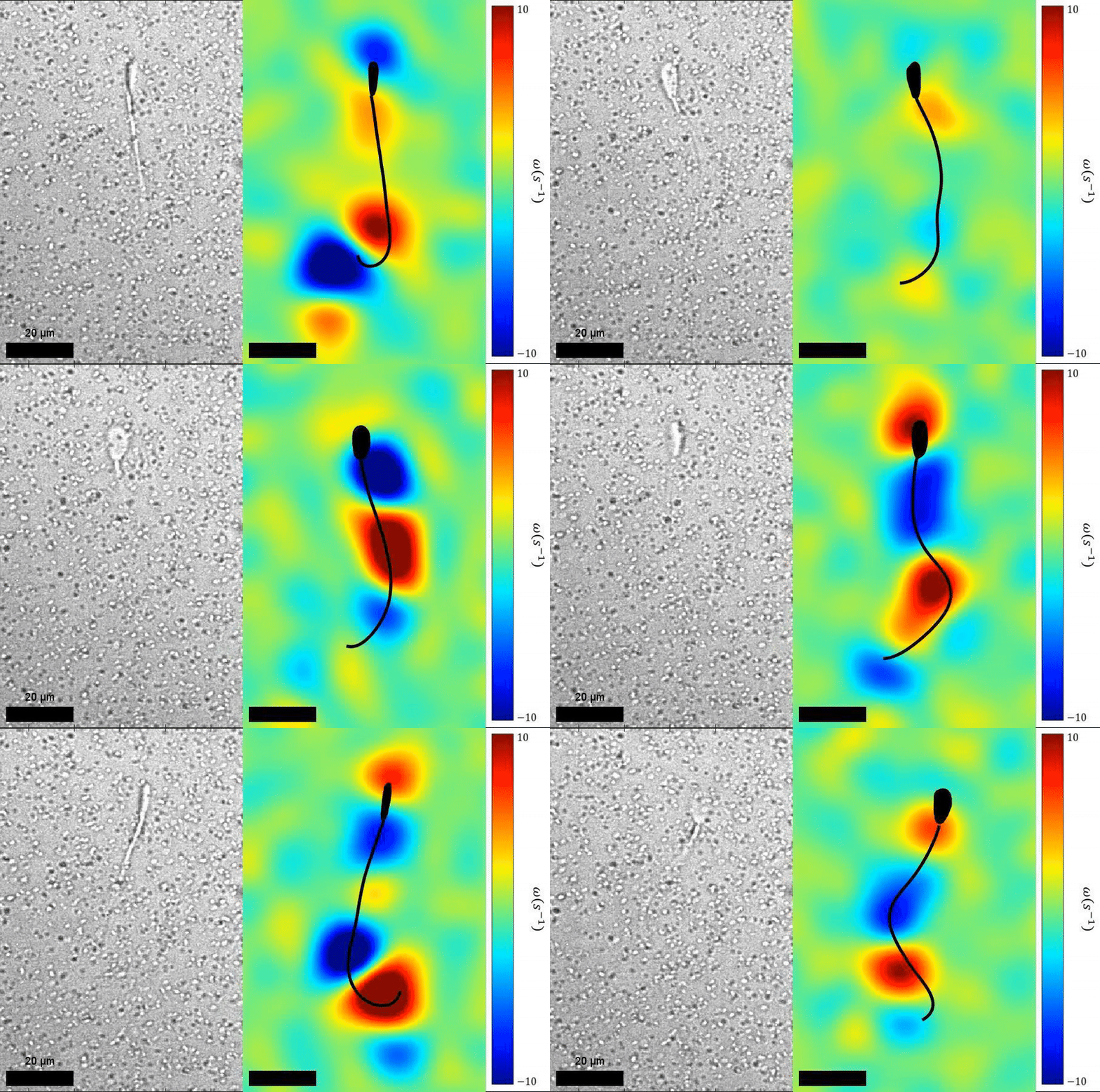 Simultaneous imaging of sperm and the surrounding hydrodynamic flow field.
Video: Supplied
Professor Nosrati said the team used advanced imaging to reconstruct the 3D flow field around sperm.
"Imagine taking a straight rubber band and twisting it into a spiral. Now, add another turn to create a superhelix – a tightly coiled, extra-twisted structure," Professor Nosrati said.
"For sperm, this extra twist in the fluid enhances their movement, following them as it tightens, allowing them to swim more efficiently.
“As the sperm swims, its flagellum (tail) generates a whipping motion that creates swirling fluid currents that optimise their propulsion in the reproductive tract. What’s really fascinating is how these spiral-like ‘imprints’ in the surrounding fluid attach to the sperm body and rotate in sync, adding extra thrust.”
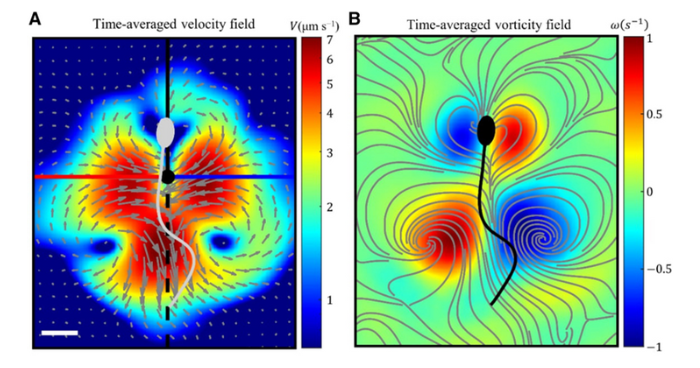 Time-averaged flow field around a near-wall swimming sperm, following the stresslet model flow decay.
Picture: Supplied
Beyond fertility research, the findings have broader implications for understanding how other microscopic swimmers, such as bacteria, move and adhere to surfaces, which could inform studies on infection spread or biofilm formation.