Robots in the wild: drawing from nature to better understand robotics
A sloth might seem like a slow motion, impractical creature that is easy prey for predators in the rain forest. But roboticists can learn much from nature, even from animals like sloths, claims one of the world’s leading roboticists, Professor Magnus Egerstedt, who is currently visiting the University of Melbourne.
Professor Egerstedt, who is the Stacey Nicholas Dean of Engineering at the University of California, Irvine, says we will increasingly see robots venturing outside their traditional structured, well-managed environments into farms, homes, hospitals and the natural environment. They will increasingly be required to perform their tasks across extended temporal and spatial scales, he says.
Ecology has motivated Professor Egerstedt to study the interactions between robots and their environments to better understand design for long-term robot autonomy, and to find ways that robots can help our environment and humans, from disaster relief to precision farming.
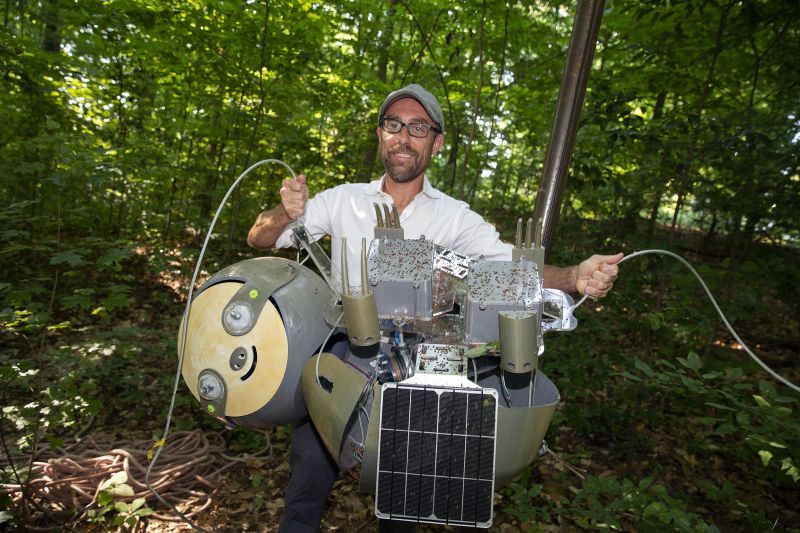
Professor Egerstedt with the sloth robot.
Prof Egerstedt has developed a ground-breaking new framework that draws on the principles of ecology for the design and analysis of long-duration robots. He explains how robots can be designed to take advantage of their surroundings, including using natural energy sources such as solar power.
“Ecology is a beautiful field of study. When you study an elephant in its natural habitat, you look at the entire ecosystem, and that’s how you understand how something works. Until now, robotics has very much been you do it in the lab, and then you hope they work in the wild. That can’t be the right model – coupling robots with environments is the answer,” Prof Egerstedt said.
Prof Egerstedt became interested in sloths and their low-energy lifestyles while on a family trip to Costa Rica. The animals prompted him to consider energy efficiency and how it relates to robots used for precision agriculture, environmental monitoring and other long-duration tasks.
He collaborated with robotics engineers at the Georgia Institute of Technology (Georgia Tech) to build ‘SlothBot,’ a slow-moving and hyper-energy efficient robot. SlothBot demonstrates how purposeful slowness might improve energy conservation in environmental robots. It also proves that there is much of nature to leverage in robotic technology and research.
Prof Egerstedt also founded The Robotarium for researchers interested in swarm robotics to test their theories on actual hardware. The open-access lab houses palm-sized ground and flying robots. Anyone in the world can create their own code, upload it to the Robotarium, and see footage of the robots executing their commands.
“Robotics as a field has seen an amazing evolution over the past ten plus years,” he said.
“What we can do today is so different to two decades ago and we can expect the rapid development to continue. All of a sudden, the brain is more advanced than the body in robots. If the last decade was the time for the brain, then the next is going to be on the body and the ‘hand.’ Imagine how much more robots will be able to help us in another decade.”
Prof Egerstedt is visiting the University as part of the Miegunyah Distinguished Visiting Fellowship Program. During his time here, he will be working with Prof Girish Nair, Head of the Control and Signal Processing Research Group in the Department of Electrical and Electronic Engineering, to further explore the role of robotic collision as a source of information.
Prof Egerstedt will discuss Robots in the Wild at a public lecture on Thursday 30 June (6-7 pm) in Lecture Theatre 1 (B103) at the School of Population Health. The presentation will explore the current state of robotics and AI, as well as the technological and societal factors that have led to the use of robots in natural environments over sustained periods of time. For more information and to register, visit: https://www.eventbrite.com.au/e/robots-in-the-wild-a-miegunyah-distinguished-visiting-fellow-lecture-tickets-331620725517