Students launch into Australian rocketry history
Australian students have launched a first for the nation on the international stage with a successfully tested rocket engine made using 3D printing.
Affectionately known as Slinky, the rocket engine was made by students from the University of Melbourne with the help of researchers from CSIRO’s Lab 22, Australia’s national centre for additive manufacturing innovation.
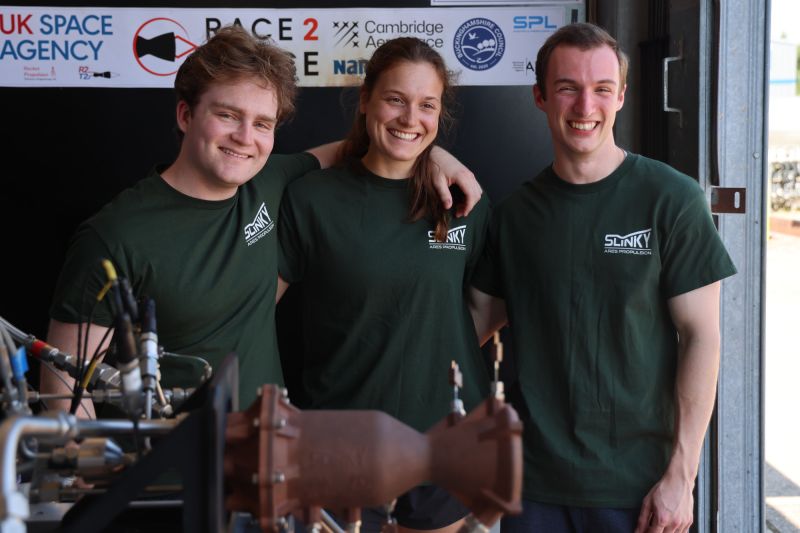
From left: Students Jack Gardiner, Brooke Doolan and Stuart Davis.
As part of a University of Melbourne Aerospace and Rocket Engineering Society (ARES) Capstone Project, Lab22 collaborated with a three member rocketry team to design and manufacture a regeneratively cooled liquid bipropellant rocket engine, a student milestone rarely attempted and never before successfully fired by an Australian team at Race2Space, one of the world’s premier student rocketry events. The trio won the LOX bipropellant category against an outstanding group of international teams in the competition.
Working closely with Lab22 scientists and engineers, Aerospace and Mechanical Engineering Master’s students from the Faculty of Engineering and Information Technology, Jack Gardiner, Brooke Doolan and Stuart Davis developed a fully integrated engine, featuring embedded micro cooling channels within the chamber wall to enable regenerative cooling—an advanced design approach typically reserved for professional aerospace programs.
Senior research scientist and team leader at CSIRO, Dr Cherry Chen, explained that the project showcases the power of advanced metal 3D printing to unlock complex geometries and high performance designs that traditional methods simply cannot achieve. A primary challenge of rocketry is cooling, and this engine solves this by utilising internal cooling geometry which can only be achieved through computational design and additive manufacturing.
“Lab22 provided expert guidance on material selection, mechanical behaviour and design for additive manufacturing, enabling the team to optimise the engine for high performance operation,” Dr Chen said.
“We used Lab22’s Nikon SLM Solutions 280 2MA laser powder bed fusion system at Clayton, Victoria to produce the engine in a copper alloy that was specifically chosen for its exceptional thermal conductivity and suitability for high heat flux environments.”
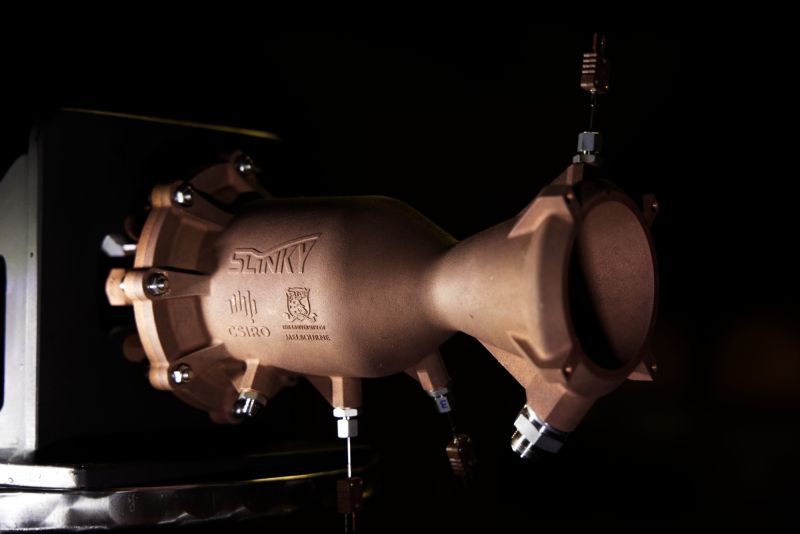
Earlier this month, the students transported the rocket engine to the United Kingdom to compete in Race2Space. Weighing approximately 6kg, Slinky is about the size of a large pineapple.
Team member Stuart Davis said Slinky achieved five clean, stable hot fires in one day. These included a couple of throttling runs, resulting in a maximum thrust of 5.4 kilonewtons (kNs) (comparable to a small lunar lander engine)[TW2.1][GC2.2], securing victory in the LOX bipropellant category against a competitive international field. The engine was mounted on a welded steel thrust structure designed to interface with Airborne Engineering's test facilities.
”We're absolutely thrilled to be at the cutting edge of computational engineering and demonstrating the results that its integration can achieve,” he said.
This accomplishment represents a landmark moment. It is the first regeneratively cooled liquid rocket engine ever successfully fired by an Australian student team at Race2Space.
Chair and Professor of Computational Mechanics at the University of Melbourne Professor Richard Sandberg, supervised the capstone project, where final-year students apply accumulated knowledge to a research challenge. He said the successful test fires show what is possible when you combine computer-assisted design and additive-manufacturing with motivated students.
“This rapid concept-to-test approach will speed up development cycles in engineering, helping to innovate and bring down cost,” Professor Sandberg said.
“Our Aerospace and Rocket Engineering Society pushes the boundaries of student engineering and has seen numerous successes in technological development and international recognition.
“Collaborations such as this project with Lab22 help us to foster a culture of growth, challenge and development — providing Australia’s future space innovators with environments to test their limits and discover what aerospace has to offer.”
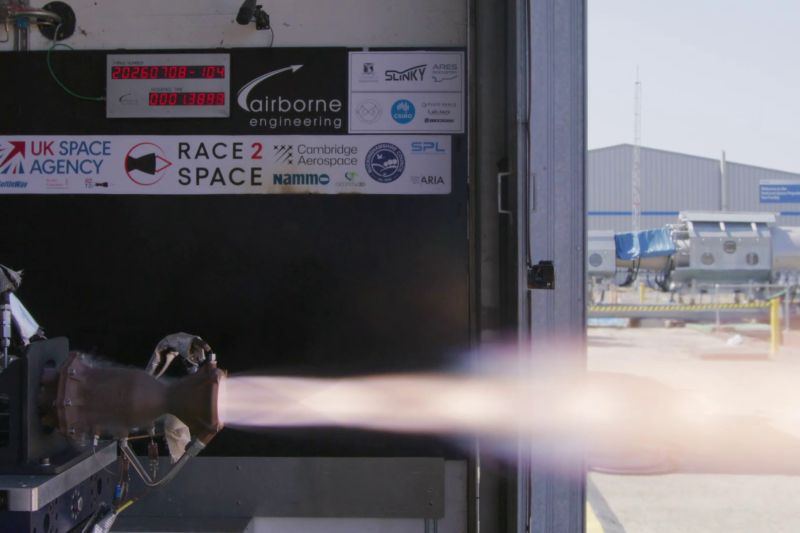
Lab22’s involvement demonstrates the transformative impact of additive manufacturing on next generation aerospace development and highlights the organisation’s commitment to supporting emerging engineers and advancing sovereign capability in high performance propulsion systems.
“We are incredibly proud of Jack, Brooke, and Stuart for pushing boundaries and demonstrating what Australian engineering talent can accomplish,” said Dr Chen.
Ms Doolan added that the success was “a big step forward for ARES Rocketry”.
“It opens the door to more complex propulsion design and manufacturing, with hopes to integrate Slinky into a future rocket and drive the next generation of propulsion development at the university,” she said.
More Information
Professor Richard Sandberg