Students preserve memories in gemstones with EchoGems
A team of University of Melbourne final-year Masters students has reimagined the future of memory preservation with ‘EchoGems’, an experimental device that stores voice messages inside gemstones.
The device was created by Amy Zuell (Master of Mechatronics Engineering), Frank Artnarong, JoAnn Nguyen and Wu Jia Tan (all studying a Master of Information Technology in Human-Computer Interaction), as part of the ‘Designing Novel Interactions’ (INFO90003) subject led by Dr Adelaide Genay and Ms Mel Huang Buntine. Students were asked to respond the theme Science Fiction, inspired by Science Gallery Melbourne’s exhibition ‘SCI-FI’.
Set in a future where digital data has been lost to a global catastrophe, ‘EchoGems’ offers an alternative form of memory storage – one that is tangible and enduring. The project imagines a world where memory must be preserved not in the cloud, but in crystal.
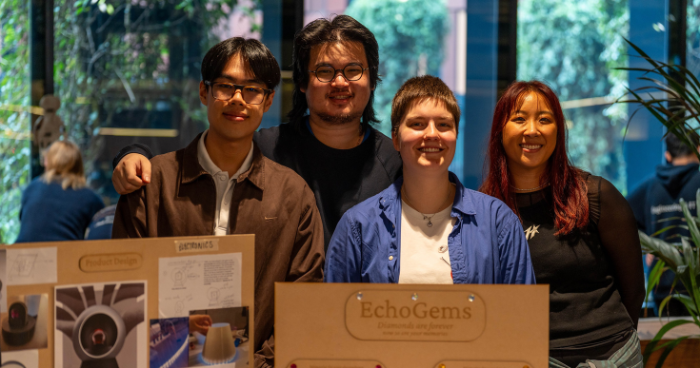
L-R: Wu Jia Tan, Frank Artnarong, Amy Zuell and JoAnn Nguyen.
Picture: Shaanan Cohney
To use the device, users place a gem into the EchoGem encoder and speak aloud a chosen memory - perhaps a loved one’s laugh, the first words of a child, or a message to someone in the future. They have ten seconds to record. Once encoded, the gemstone can be tapped on the reader to play back the memory through soft audio and light. It’s a simple gesture that feels like unlocking a moment in time.
The device uses gems with Near Field Communication (NFC) tags, a Radio Frequency Identification (RFID) reader, and a microcontroller. These technologies enable wireless communication over short distances, in the same way your Myki card or credit card “taps on” at a terminal
“We were really interested in the idea of giving physical form to something intangible,” Amy said.
“Memory is so fleeting, and we wanted to explore how emerging technologies could be used to create something meaningful, even beautiful, from that fragility.”
The concept was sparked by speculative design examples shown in lectures, including Durrell Bishop’s marble answering machine, which used physical marbles to store messages, in combination with record-breaking research around using lasers to encode information in diamonds long-term.
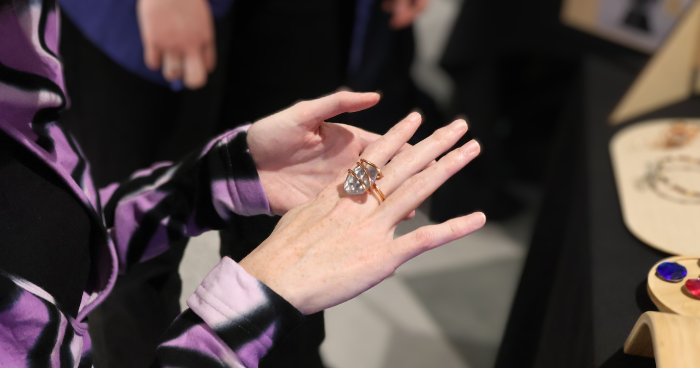
A visitor wears a gemstone ring, designed as a future heirloom capable of storing audio memories.
Picture: Megan van Vegten
“We wanted to create something speculative but grounded in real emerging technologies,” Frank said.
“The idea of preserving memories in something as lasting as a gemstone really resonated with us,” JoAnn added.
“We were inspired by how physical design can make intangible concepts like memory feel more real and emotionally powerful,” Wu Jia said.
 When a gem is placed on the device, the embedded NFC tag triggers an RFID scan that activates recorded audio and coordinated lighting effects. Picture: Jian Zhang
The project was developed over a semester, with the team spending six weeks focused on ideation and learning the necessary technical and fabrication skills before building the final prototype.
The project was developed over a semester, with the team spending six weeks focused on ideation and learning the necessary technical and fabrication skills before building the final prototype.
Co-Lecturer Ms Mel Huang Buntine said: “EchoGems are a brilliant example of speculative prototyping and creative interaction design.
“The students brought strong technical skills and a sensitive, imaginative approach to the theme of Science Fiction. It’s a standout project in the cohort and resonated with all the guest judges. It’s a great example of human-centred versus technology-led thinking and making prototypes that can resonate with the general public.”
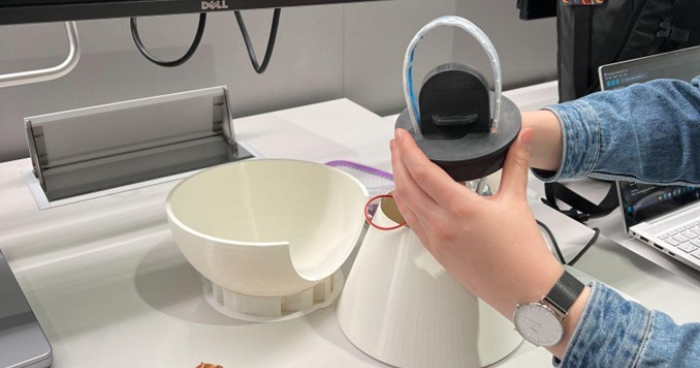 The team used 3D-printed parts, copper wire, MDF, LEDs, and custom Python scripts.
Picture: Supplied
The team received the Best Build award at Melbourne Design Week’s Cybernetic Futures Showcase awarded by subject mentors at Creator Space and was selected by the FEIT’s Senior Curator Richard Gillespie to display their work as part of the permanent collection. It will also be displayed during Melbourne Connect’s Innovation Week (1-5 September).
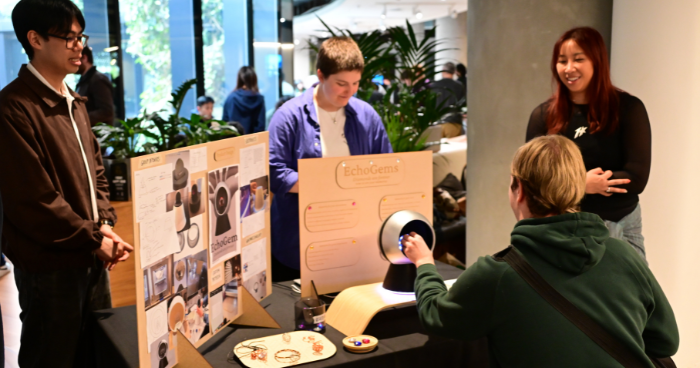
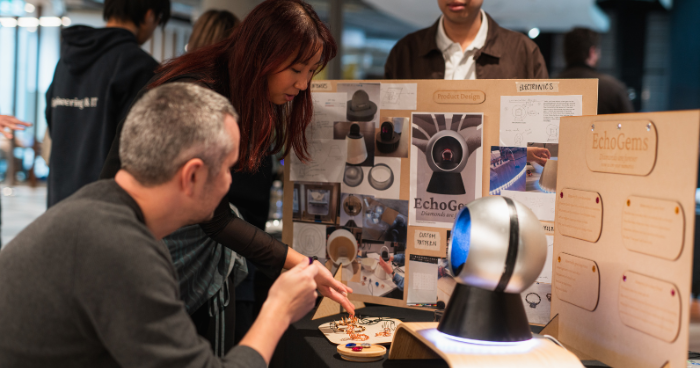 Students demonstrate EchoGems to a visitor, who records a memory by placing a gem into the prototype.
Picture: Anthony Richardson
Though the team has no plans to continue development at this stage, their work points to a future where memory, technology and materials intersect, offering new possibilities for how we remember and what we choose to leave behind.