University spinout R2Crete raises $750,000 to advance waste concrete recycling
R2Crete, a University of Melbourne spinout pioneering a breakthrough concrete recycling technology, has secured $750,000 in pre‑seed funding from the University of Melbourne Genesis Pre-Seed Fund and Uniseed.
Concrete is the world’s most widely used construction material and accounts for an estimated seven to eight per cent of global carbon emissions, a footprint expected to grow in the coming decades.
R2Crete’s patented process transforms waste concrete into high‑value clean aggregates and a cement replacement that can be reused in new concrete production, significantly reducing carbon emissions, landfill waste and the demand for raw materials such as sand, gravel and limestone.
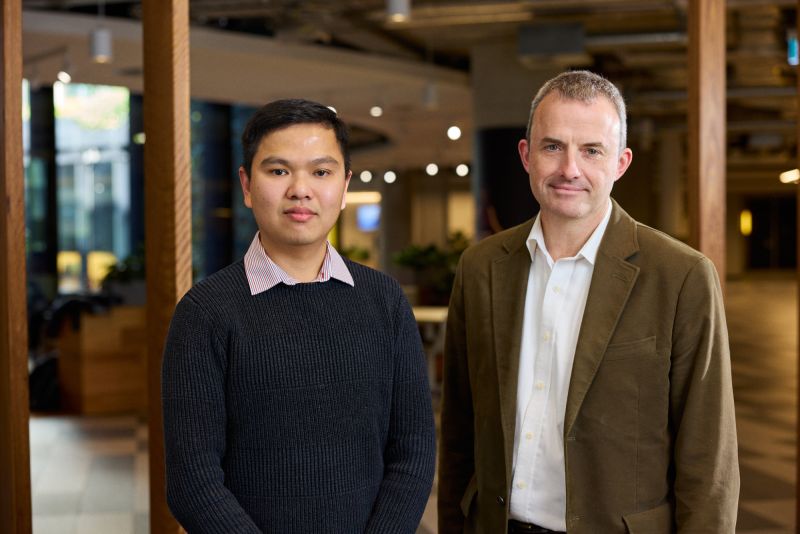
Dr Tuan Nguyen and Mr Warren Overton.
The technology, which is based on research developed by Dr Tuan Nguyen, Senior Lecturer in the Faculty of Engineering and Information Technology, can recover up to 75 per cent of the cement in waste concrete, delivering a 50 per cent reduction in CO2 emissions, while retaining the performance characteristics of traditional concrete.
In Australia alone, an estimated seven million tonnes of waste concrete is generated each year – a figure that could exceed two billion tonnes globally.
With early support from the University’s Proof-of-Concept Fund, Dr Nguyen and Co-Founders Warren Overton and Professor Mahdi Miri Disfani joined the Melbourne Entrepreneurial Centre’s Translating Research at Melbourne (TRAM) program to sharpen their go-to-market strategy. The team also received funding from Australia’s Economic Accelerator (AEA) Ignite program.
The current raise marks a major milestone in the company’s commercialisation journey and will support the construction of R2Crete’s pilot commercial plant – enabling validation of the technology at commercial scale, supply of material for industry trials, and acceleration of industry partnerships.
Warren Overton, Managing Director of R2Crete, said the investment represents a strong vote of confidence in the company’s technology and mission.
“Securing this funding from Genesis and Uniseed is a pivotal moment for R2Crete. It enables us to move from laboratory success to real‑world commercial deployment," he said.
"Our pilot plant will demonstrate that high‑value recycled aggregates and cement replacement products can be produced reliably, cost effectively and at scale – helping the construction industry transition to a more circular and lower carbon future.”
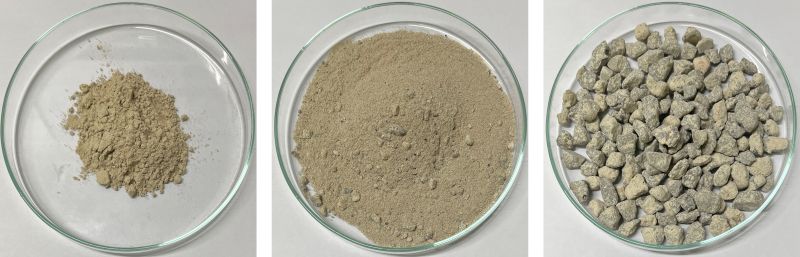
R2Crete recycled products: Supplementary cementitious material; recycled sand; and recycled aggregate
The University of Melbourne Genesis Pre-Seed Fund supports researchers, students and alumni to translate their discoveries and inventions into growing startups to benefit society. Hun Gan, Chief Executive Officer of the Fund and Executive Director of Commercialisation at the University of Melbourne, highlighted R2Crete’s potential to reshape the concrete supply chain.
“R2Crete is tackling one of the world’s largest waste and emissions challenges with a solution that is both scientifically robust and commercially compelling. We’re excited to support the team as they build their pilot plant and take the next step toward transforming how concrete is recycled globally,” he said.
Jeffrey Bourne, Investment Manager at Uniseed – Australia's longest running research commercialisation fund – highlighted the technology's scalability and commercial potential.
“The R2Crete process stands out for its ability to produce high-quality recycled and low-carbon materials suitable for concrete production in a cost-effective and efficient manner. We believe R2Crete is well-positioned to become a leader in sustainable construction materials, and we’re proud to back their journey from research to commercial reality.”
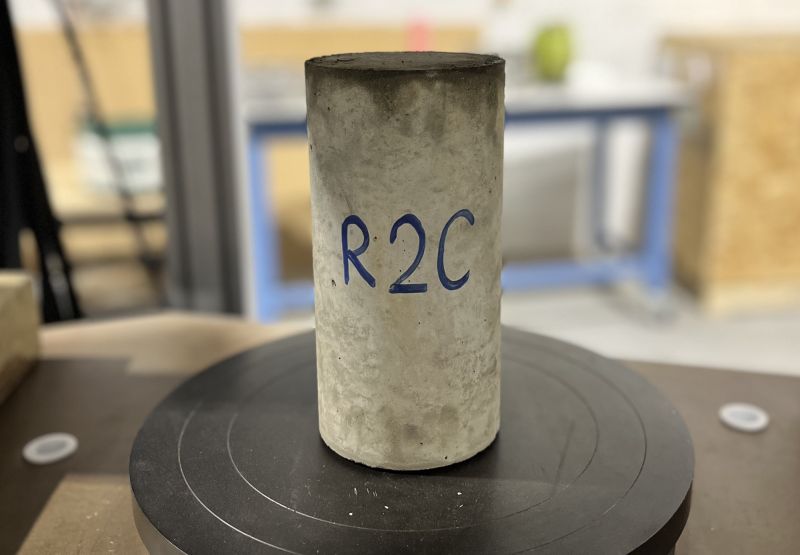
Compression test of concrete sample made of R2Crete recycled products.
R2Crete are currently progressing discussions with a range of industry partners to undertake field trials using material produced from the pilot plant. Construction of the plant is expected to be complete by late 2026, with field trials to commence in early 2027.