Guidelines offer path for digital inclusion for Indonesian people with a disability
University of Melbourne Professor Shanton Chang has co-authored a set of foundational guidelines for organisations seeking to improve online engagement with the diffable community.
Together with Dr Sudirman Nasir and Rafika Ramli from Indonesia’s Hasanuddin University, Muhammad Syarif Ramadhan and Dr Ishak Salim from the Indonesian Disability Movement for Equality, Pergerakan Difabel Indonesia untuk Kesetaraan (PerDIK), and Professor Jeannie Paterson and Mr Timothy Kariotis from Melbourne Law School at the University of Melbourne, the co-authors have taken an important step towards digital inclusion.
Professor Chang is based in the Faculty of Engineering and Information Technology’s School of Computing and Information Systems.
 Published by the Australia-Indonesia Centre (AIC), the Guidelines offer an important step towards creating inclusive services and environments for people with a diffability in Indonesia.
Governments, corporations, community organisations and institutions are increasingly relying on digital interventions to communicate with citizens, stakeholders, consumers and students. With the increased emphasis on digital solutions, the diffable community is sometimes overlooked, resulting in a lack of engagement from civil society. Even when organisations consider the requirements of the diverse population, responses are sometimes ad hoc and uneven.
 Institute team's experience working with a range of disability community groups. Credit: PAIR
The inclusion of South Sulawesi’s young diffable community is particularly significant, since they are interested in using digital interventions as a form of empowerment, identified by researchers in 2021.
The project is part of the AIC's Partnership for Australia-Indonesia Research (PAIR) project, with the guidelines spanning digital solutions from planning to implementation.
The researchers have built on and adapted the existing Ethical and Equitable Digital Design Matrix for Community Engaged Research, which was developed by the Melbourne Social Equity Institute to support the ethical and equitable design elements of digital technologies.
 Group of eight women using sign language. Credit: PAIR
“The matrix was initially developed to support digital design with members of the community and community organisations in Australia,” Professor Chang said.
“Through consultation and co-design with the community and local stakeholders, we have adapted the matrix for use in Indonesia, specifically South Sulawesi, to better suit the needs of the Indonesian diffable community.
“We also hope that the guidelines will help Indonesian organisations collaborate more closely with the diffable communities to ensure more accessible and equitable digital solutions.”
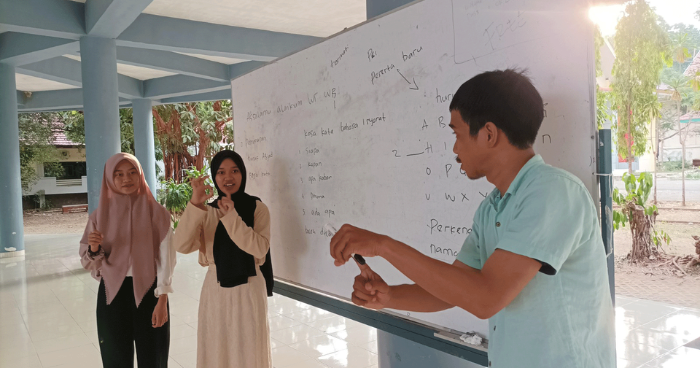 Sign language is demonstrated amongst the Indonesian diffable community. Credit: PAIR
The research is funded by the Australian Department of Foreign Affairs and Trade.
Learn more about the guidelines here: https://pair.australiaindonesiacentre.org/research/digital-inclusion-guidelines-for-people-with-disability-the-role-of-the-matrix/