Student-programmed office robot assistant wins top prize at HRI24
A group of students from the Faculty of Engineering and Information Technology (FEIT) captured the spotlight at the Association for Computing Machinery and Institute of Electrical and Electronics Engineers’ International Conference in Human-Robot Interaction (HRI24) competition in Boulder, Colorado, with their robot assistant, ‘OfficeMate.’
The HRI24 Robot Challenge's Office Assistant Robot competition challenged contestants to create social robot applications built on the TIAGo Platform that would provide valuable assistance and companionship to office workers.
Aptly named Team Melbourne, the team includes School of Computing and Information Systems (CIS) students Yan Zhang, Jiahe (Michael) Pan, Sarah Schombs, Muhammad Bilal and Ramtin Tabatabaei. Dr Wafa Johal, senior lecturer in CIS, supervised the students.
Team Melbourne received the Robot Competition Winner award, which acknowledges the top entry to the HRI24 robot competition.
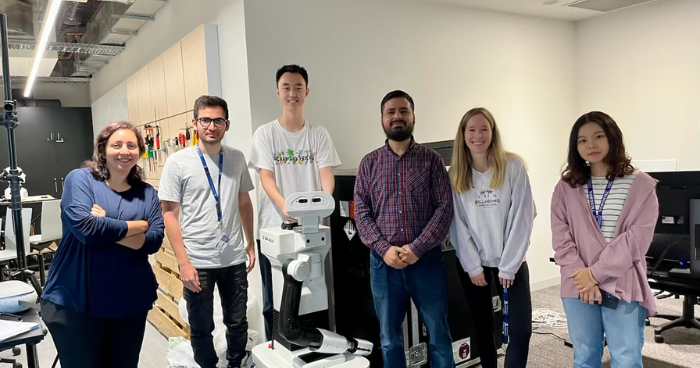 From left: Dr Wafa Johal, Ramtin Tabatabaei, Jiahe (Michael) Pan, Muhammad Bilal, Sarah Schombs and Yan Zhang.
The team’s journey began in January 2024, when they received the Tiago robot manipulator from PAL Robotics. This acquisition was made possible through the generous funding of FEIT’s Collaborative Equipment Grant, in collaboration with the Departments of Mechanical Engineering (Dr Denny Oetomo) and Electrical Engineering (Dr Ye Pu).
With a clear objective in mind, the team set out to create, program and demonstrate an office assistant robot capable of navigating complicated surroundings, interacting socially with humans, and executing a variety of office activities with ease and efficiency.
To prepare for the competition, the team underwent a rigorous one-week boot camp in February. During this period, they honed their skills in programming Tiago’s basic functionalities, laying the groundwork for the advanced capabilities they would later showcase. These skills encompassed mapping, simultaneous localisation and mapping, object manipulation, follow-me behaviour and speech interaction using Large-Language Models.
 Team Melbourne working on OfficeMate in the IxT Lab.
The HRI24 competition presented an unexpected challenge when a snowstorm forced the closure of the campus on the second day of the conference. Undeterred by the adversity, the competition organisers swiftly moved the event online. The team seized this opportunity to demonstrate the impressive capabilities of OfficeMate in a virtual format.
OfficeMate autonomously performed a series of complex tasks designed to simulate the role of an office assistant using large language models, which are advanced artificial intelligence systems trained on vast amounts of text data to understand and generate human-like language.
From conducting breathing exercises to booking rooms and calendars, guiding visitors, and even fetching snacks, the robot's performance showcased its practical assistance, social interaction and innovative user experience capabilities, perfectly aligning with the competition's criteria.
 Jiahe (Michael) Pan and Ramtin Tabatabaei debugging OfficeMate’s navigation.
Dr Johal said the team’s success at HRI24 is a testament to their collaborative efforts and the transformative potential of robotics in enhancing human experiences.
“We are thrilled to have demonstrated the capabilities of OfficeMate and look forward to pushing the boundaries of innovation even further,” Dr Johal said.
The contestants were evaluated on various criteria, including practical assistance, social interaction, navigation and environment interaction, and innovation and user experience.
The triumph of Team Melbourne at the HRI24 competition not only exemplifies the dedication and ingenuity of its members but also underscores the remarkable progress being made in the field of robotics and human-robot interaction.
Watch a demo video of OfficeMate here: https://www.youtube.com/watch?v=FzSA27W1sek