Turning solar panel waste into sustainable building materials
University of Melbourne researchers are driving efforts to recycle solar panel glass into sustainable concrete – research that has informed a field trial under way as part of Victoria’s North East Link project.
Led by Dr Massoud Sofi and Dr Zipeng (Rick) Zhang, in collaboration with Australian solar panel upcycling facility ElecSome, the research team has supported the development of a recycled alternative to natural sand, made from crushed, end-of-life solar panels.
The product, known as solar glass sand, is blended with up to 50 per cent natural sand and is now being tested in partnership with Australian construction materials company Boral and the Spark North East Link Design and Construct Joint Venture.
 The concrete mix uses solar glass sand, a recycled material created by crushing discarded solar panels, as an alternative to natural sand. Picture: Boral
Dr Sofi and Dr Zhang are Research Fellows in the Department of Infrastructure Engineering in the Faculty of Engineering and Information Technology.
With global demand for construction sand rising and suitable natural deposits dwindling, the research team has been investigating alternative materials to reduce environmental impacts and drive circular economy outcomes in infrastructure.
“We’re tackling two major sustainability challenges at once with this trial – construction sand scarcity and solar panel waste,” Dr Zhang said.
“By transforming glass from decommissioned solar panels into high-performance sand for concrete, we’re extending the life cycle of materials that would otherwise end up in landfill.”
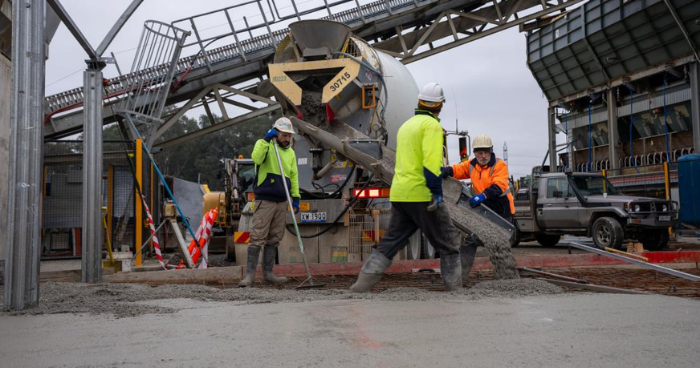 A field trial is under way as part of Victoria's North East Link project. Picture: Boral
The team worked closely with industry partners to investigate the material’s performance in concrete mixes, conducting laboratory testing to check plastic properties like workability and finish, as well as hardened properties to ensure the concrete met industrial strength and durability standards.
“Our infrastructure must adapt to a world where sustainability is no longer optional,” Dr Sofi said.
“This work shows that we can re-engineer waste into a valuable resource, without compromising quality or performance.”
Preliminary trial results have shown strong performance, and a concrete slab using the solar glass sand mix has already been laid on-site at the North East Link project, the biggest infrastructure investment in Melbourne’s north-east, which will construct 6.5 kilometres of tunnels.
As the trial progresses, the research team will continue to contribute expert insights towards long-term performance and material optimisation.
Learn more here: https://www.boral.com.au/boral-trials-recycled-end-life-solar-panels-sand-concrete