Synchron raises US$75m Series C funding to advance endovascular brain-computer interface
Entrepreneurs such as Bill Gates, Jeff Bezos and Robert Nelson (ARCH Venture Partners) have committed to support the start-up Synchron, an endovascular brain-computer interface (BCI) company, which has reached another milestone in its meteoric rise.
Synchron was founded by University of Melbourne’s Associate Professor Tom Oxley (CEO) and Professor Nicholas Opie (CTO).
Synchron’s technology, Stentrode™, is implanted within the motor cortex of the brain via the jugular vein in an endovascular procedure. It was listed in Time Magazine’s Top 100 Inventions of 2021. The system aims to “provide treatment for debilitating medical illnesses and enable patients to feel empowered by reconnecting online in ways that dramatically improve their lives”.

Associate Professor Tom Oxley and Professor Nicholas Opie.
The company announced on 15 December 2022 an oversubscribed USD$75 million Series C financing round, led by ARCH Venture Partners. Other new investors are Gates Frontier, Bezos Expeditions, Reliance Digital Health Limited, Greenoaks, Alumni Ventures, Moore Strategic Ventures and Project X.
Existing investors, including University of Melbourne, Khosla Ventures, NeuroTechnology Investors, METIS, Forepont Capital Partners, ID8 Investments and Shanda Group, also participated in the round. The Series C funding brings the total amount raised since inception to USD$145 million.
The funds will accelerate product development, facilitate commencement of a pivotal clinical trial and advance Synchron towards a first-in-class BCI market approval for the treatment of paralysis. Synchron Switch™ BCI will be Synchron’s first platform product.
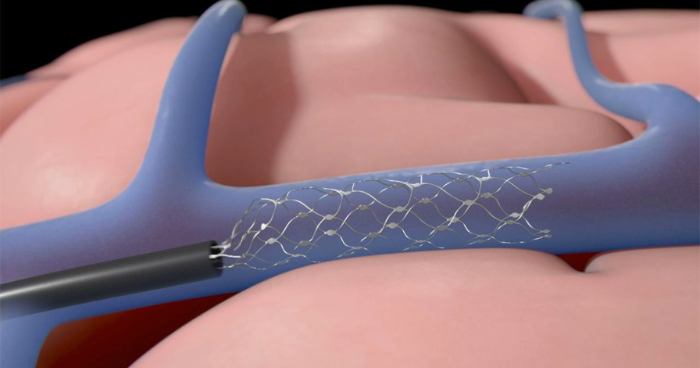
The Stentrode expands inside a blood vessel on the brain to relay motor signals (Illustration courtesy of Synchron).
Associate Professor Oxley said four Australians in Melbourne have received a Stentrode implant as part of clinical trials to establish safety since 2020:
We have an opportunity to deliver a first-in-class commercial BCI. The problem of paralysis is much larger than people realize. 100 million people worldwide have upper limb impairment.
We are extremely excited to work with ARCH and this world-class syndicate to bring this technology to the people who need it.
He said Synchron is working to create multiple new high-skill jobs employment opportunities in Australia in basic and clinical research, bioengineering and manufacturing, and to enhance Australia’s global competitiveness in biomedical innovation.
Associate Professor Oxley is a vascular and interventional neurologist and world expert in brain computer interfaces. He completed his PhD in neural engineering in FEIT’s School of Biomedical Engineering in 2016, in signal processing, image processing and medical device development. He is a Principal Research Fellow in the Faculty of Medicine, Dentistry and Health Sciences (MDHS), joint Head, with Professor Opie, of the University’s Vascular Bionics Laboratory, and Clinical Instructor, Attending, in the Department of Neurosurgery, Mount Sinai Hospital.
Melbourne-based Professor Nicholas Opie is a biomedical engineer and world expert in neural interfaces. He is a Professor in MDHS and an NHMRC Research Fellow. Professor Opie said Synchron was encouraged by the strong support from some of the world’s most successful technology innovators:
The device is able to help a plethora of people who have been impacted by paralysis for different reasons, including stroke, spinal cord injuries and motor neurone disease.
The ability to read and translate the brain’s electrical codes and signals is creating the foundations for a new global biomedical technology industry.
 The Melbourne Synchron team, with Professor Nicholas Opie (front, centre left).
In 2019 the team received the Australian Eureka Prize for Excellence in Interdisciplinary Scientific Research and was awarded the University of Melbourne Excellence Award for Team-Based Research.
ARCH Co-Founder and Managing Director Robert Nelsen said the approach at ARCH “has always been to pair great science and technology with remarkable teams to build disruptive companies”.
“The technology we witnessed at Synchron is helping people with previously untreatable conditions regain connection to the world. It is an exciting time for neurotechnology.”
The Synchron Switch™ brain computer interface is implanted in the blood vessel on the surface of the motor cortex of the brain via the jugular vein, through a minimally-invasive endovascular procedure. Once implanted, it is designed to detect and wirelessly transmit motor intent out of the brain, restoring a capability for severely paralysed patients to control personal devices with hands-free point-and-click.

Synchron brain implant. (Image courtesy of Synchron).
Synchron’s ongoing US clinical trial, COMMAND, assesses the impact on daily tasks such as texting, emailing, online shopping and telehealth services. The FDA granted Breakthrough Device designation to Synchron in August 2020 and an Investigational Device Exemption in July 2021.
View Synchron CEO 2022 TED Talk: “A brain implant that turns your thoughts into text.”