World-first AR display en route to production
A new era of augmented reality (AR) visual display through eyeglasses and helmets is almost here, thanks to a team of University of Melbourne (UoM) researchers and their commercial partner KDH Advanced Research Australia (KDH) and KDH’s manufacturing partner FOXCONN Technology (FTC).
After five years of collaboration, the team from the Faculty of Engineering and Information Technology at UoM and KDH are preparing for the final stage, commercialising the world’s first AR optical waveguide ‘Transmittance Integrated Guiding Enhanced Reaction’ (TIGER) display.
KDH is working with Taiwanese multinational electronics contract manufacturer FTC to trial mass production of their first product to incorporate the technology, which will be on the market by early 2025. FTC (Taiwan Stock Exchange: 2354) is a leading global ODM manufacturer, specialising in mechanical and optical technologies.
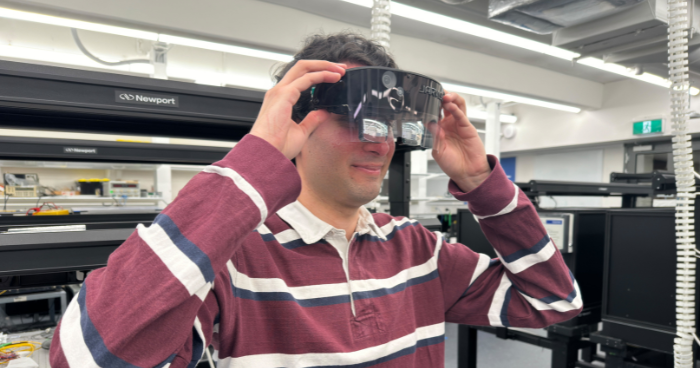 Research engineer demonstrates the TIGER Display. (Photo: Megan van Vegten)
The TIGER Display, developed by UoM-KDH, combines a plastic composite base with FTC's ultra-precision mould capabilities, enabling the production of full-colour optical AR waveguides, with significant cost advantages.
The key advancements of the TIGER display include the integration of 3D-printed or automated moulded prescription lenses, micro-display panels and relay optical components into unified display modules.
By simplifying the AR display design process, the TIGER display paves the way for a wide range of head-mounted products, making AR technology more accessible and easier to incorporate into various forms.
The technology can be mass-produced affordably, allowing users to clearly and safely view computer displays on transparent glasses, goggles or helmets. Its potential applications are wide-ranging, from reading maps while walking on a footpath to immersive educational experiences, viewing real-time full HD video transmitted from drones or remote surveillance cameras, and playing outdoor sports and games—all within the compact form factor of glasses, goggles and more.
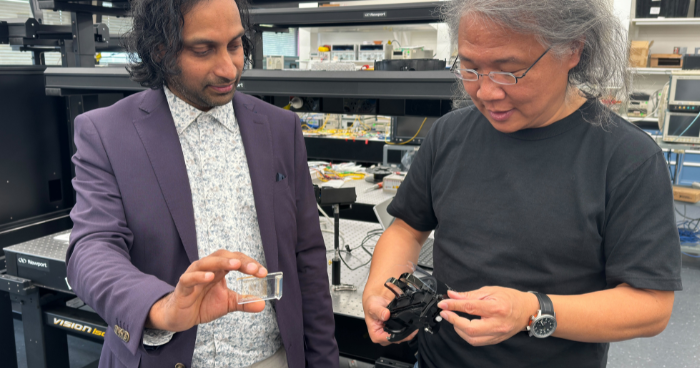 Associate Professor Ranjith Unnithan and KDH CTO Younger Liang. (Photo: Megan van Vegten)
KDH CEO Jeremy Lu, a UoM alum, said the company is producing the displays for use in motorcycle helmets through its brand.
“There is also strong customer interest for adopting the technology in other areas such as education, sport and military,” Mr Lu said.
Dean of Faculty of Engineering and Information Technology Professor Thas Nirmalathas commended the team’s work in illustrating the strength of university-industry collaboration for driving transformative research.
“Our Faculty is deeply committed to industry engagement, and this project exemplifies how our expertise and cutting-edge facilities can support every stage of industry innovation, from concept to large-scale production.”
 The TIGER display is embedded in goggles. (Photo: Megan van Vegten)
Research leader Associate Professor Ranjith Unnithan, from the Department of Electrical and Electronic Engineering, said the optical waveguide TIGER display marks a leap forward in developing low-cost AR technologies.
“We are integrating cutting-edge research into practical, scalable solutions. With these advancements, we are not just creating affordable AR products – we are setting the stage for a revolutionary phase of accessible augmented reality for everyday use,” Associate Professor Unnithan said.
“The additively manufactured AR technology will allow the mass production of these glasses or goggles at an affordable price for the first time,” KDH CTO Younger Liang said.
FTC is serving some of the world’s leading consumer electronics brands, recognising that augmented reality is a highly anticipated future technological trend. In light of this, FTC is excited to announce its collaboration with KDH as a manufacturing partner for AR plastic optical waveguides.
The TIGER display architecture integrates with spectacle lenses with a high light efficiency, which makes it ideal for the next generation of smart wearable AR devices.
Research co-leader Professor Christina Lim, also from the Department of Electrical and Electronic Engineering, said the collaboration highlights a shared commitment to pushing the boundaries of AR technology, driving innovation and making cutting-edge solutions more accessible to the global market.
 From L-R: Associate Professor Ranjith Unnithan, KDH CEO Jeremy Lu, KDH CFO Seong-Jiun Chen, KDH CTO Younger Liang and Professor Christina Lim. (Photo: Megan van Vegten)