Mallee drought report launched
A critical report identifying the Mallee community’s experiences of drought and their insights on enhancing drought resilience has been launched by the Mallee Regional Innovation Centre.
The Regional Drought Consultation Summary Report captures the findings from consultations completed over four months with a range of stakeholders, including farmers, service providers, councils, banks, statutory organisations, the tourism and environmental sectors, and government departments.
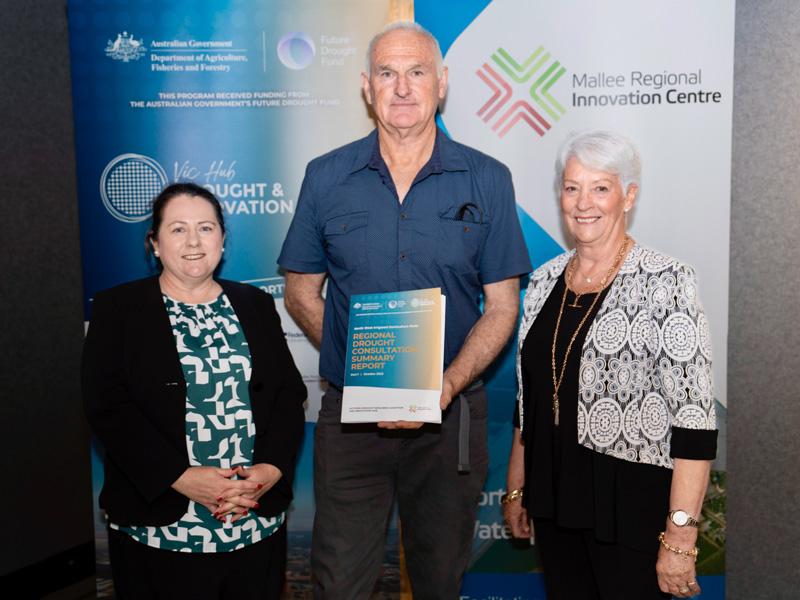
MRIC CEO Rebecca Wells, Swan Hill Rural City Councillor Bill Moar and MRIC Strategic Advisory Panel chair Leonie Burrows at the drought report launch.
It is the first in a series of reports about the ongoing drought consultations being undertaken by the Centre, which is the lead for the North-West Irrigated Horticulture Node of the Victoria Drought and Innovation Hub.
The Centre’s Strategic Advisory Panel chair Leonie Burrows OAM said drought was seen as a constant feature of life in north-west Victoria.
“When drought comes, it is first felt in the farming communities, in the transport sector and in retail industries,” Leonie said.
“The consultations indicated that recovery takes a minimum of two years for dryland agriculture and four years for irrigated horticulture. Negative news stories also affect tourism industries, while consecutive years of drought lead to exits from farming.
“The outputs of this consultation process are not only building up the institutional memory of how we have adapted to the changing face of drought, but they will guide projects and activities that will have lasting impacts for the regions.
“We have heard that the next drought will be different, but we can prepare ourselves and be better placed to continue to adapt next time.”
Centre CEO Rebecca Wells said the importance of preparing a drought plan during the good times was highlighted in many consultations.
“Ideally this would involve farmers or business owners sitting down with their agronomists, accountants and bankers to think about the business as a whole,” Rebecca said.
“Having a plan helps to reduce uncertainty and supports better decisions during droughts, which can improve our mental health.
“Improved management of mental health before, during and after the next drought is a key concern for the people of our region. There has been considerable attention to and work in this area, but more still needs to be done.”
You can download the report below. If you would like a hard copy, please get in touch at MRIC-info@unimelb.edu.au.
