Development Envelope Control (DEC)
At CSDILA, we harness the power of land administration, geospatial information, and land intelligence to create solutions for a more sustainable, resilient, and connected world. Our research pushes boundaries—transforming the way we govern land, plan cities, manage risk, and shape the built and natural environments. Each of our Research Impact Areas demonstrates how innovative spatial thinking can deliver tangible benefits for communities, industry, and governments worldwide.
Find out about our strategic and major research projects
Overview
Currently there is a challenge for urban planners and designers to understand the environmental and physical implications of design rules including building height and setback on development of an area. The collaboration leveraged our Digital Twin for the design and development of an intelligent tool for generating an optimised building envelop based on planning controls. This tool can assist urban planners and designers to achieve good design outcomes that respond to character, microclimate, and heritage.
Our research team developed a method of generating development envelopes with statistics by analysing building footprints, setback rule sets, road network and other constraints.
This project is a collaboration between CSDILA and the University of Melbourne’s Campus Planning and Design team.
Capabilities
The current capabilities include:
- Development Envelope Control Creator: create new development envelop control and define default rulesets and constraints including corridors rules.
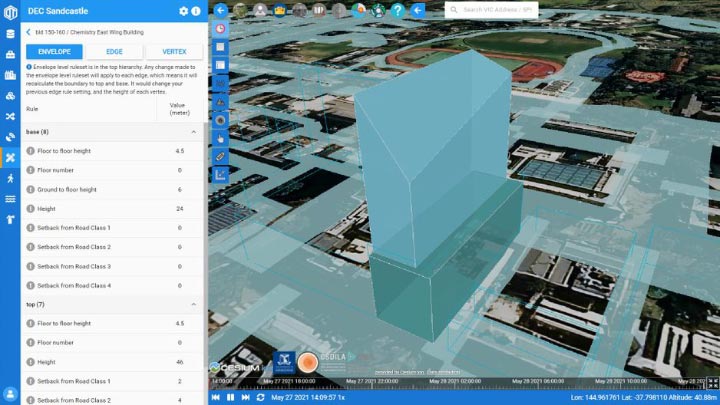
- Development Envelope Control Editor: designing three hierarchy level of ruleset constraints include envelope level (height constrains, number of floors, setbacks based on road classes), edge level (setbacks), vertex level (vertex height)
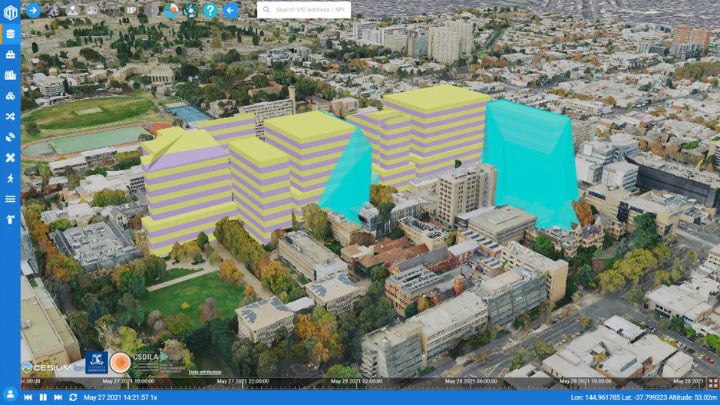
- Rule-based Development Envelope Control Evaluator: Generate 3D building blocks with statistics includes total lot area, number of floors, top area, envelope height, envelope discrepancy area, total gross floor area, floor area.
- Shadow analysis: generate single or animated 2D & 3D shadows from selected building envelopes and also highlight the shadow impacted buildings.
- Styling: define the model appearance based on the floor types