Kernot Oration: Shaping Australia's Future Through Engineering
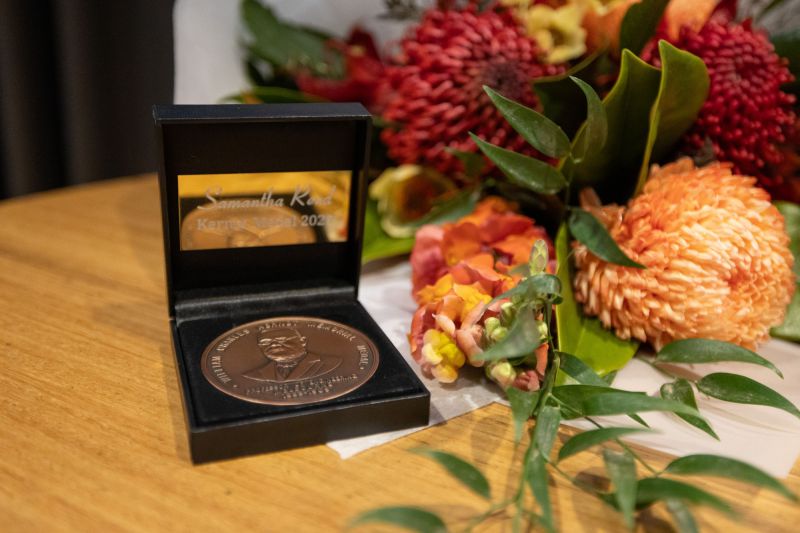
The 2026 Kernot Memorial Medal has been presented to Samantha Read FAICD FRACI BEng (Hons), in recognition of her distinguished contributions to engineering and their impact across industry and public policy. The Medal recognises distinguished engineering achievement in Australia and is bestowed by FEIT in memory of Professor William Charles Kernot, the University's first professor of Engineering.
From advancing manufacturing capability and sustainability initiatives, to influencing policy and regulatory reform, Ms Read’s leadership has made a lasting contribution to Australian industry. The following is an abridged version of the Kernot Memorial Medal Oration, delivered by Ms Read on Thursday 22 October at Melbourne Connect.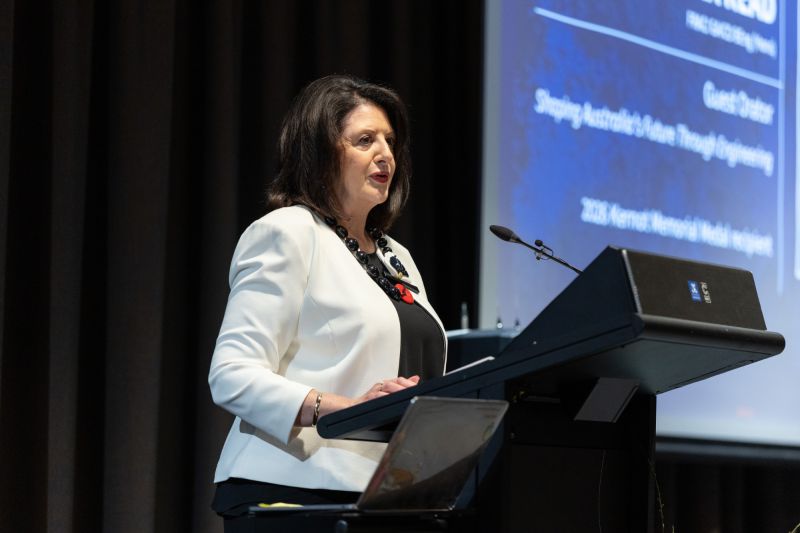
Circularity
When I was thinking about my future path after leaving school, I recall a conversation with a Professor of Engineering. He asked me to look around the room we were in, note all the items and realise that they were all the product of engineering.
That conversation set my future path. Consider for a moment the devices in your pockets, the methods of transportation you use, and the buildings you shelter in. These are marvels of modern engineering.
But as engineers, we are trained to look deeper, and if we are completely honest, we have often developed technology with a linear economy mindset. We extract raw materials, we transform them into brilliant products, and when their immediate usefulness ends, we discard them.
As I reflect on my early career, progress often meant optimisation, a focus on cost, budgets and ROI, which frequently led to offshoring. But over time, my perspective has shifted. Our traditional definition of optimisation was painfully narrow. We were optimising a single point in time, while ignoring the impact of that product over its life.
The circular economy is often mistakenly viewed as just "recycling." It is far more than this – it is a design and capability challenge. We must engineer waste out of the system from day one and marry circularity with life cycle thinking.
For industry, circularity shouldn’t be seen as another regulatory burden. It can be a commercial buffer against volatile global supply chains, a hedge against geopolitical fragmentation and value creator.
The 2026 Circularity Gap Report quantifies what it calls the "Value Gap". The global economy loses an estimated 25.4 trillion euros, or about 41 trillion Australian dollars, every year to linear material practices.
That roughly represents one third of global GDP, and it remains invisible in traditional economic metrics. It stems from mismanagement of materials, premature obsolescence and deterioration of our infrastructure, and the hidden costs of pollution and resource depletion that market pricing fails to capture.
Closing this gap is a massive strategic opportunity. When we combine circular design with life cycle thinking, we stop being just builders of objects. We become stewards of systems.
For two years, I contributed as a member of the Federal Environment Minister's Circular Economy Advisory Group. Chaired by the Hon John Thwaites, we delivered the Circular Advantage Report to Government in December 2024.
It has 14 core recommendations, and highest priority areas of:
- The built environment,
- Food and agriculture,
- Resources, including critical minerals and manufacturing, and
- Water.
The report highlights that by acting as an early mover, Australia stands to gain massive economic benefits, whereas lagging risks us becoming a dumping ground for low-quality, non-recyclable goods.
We are still struggling with the economics of circularity, with recycled materials often priced higher than virgin materials and there are challenges achieving economies of scale. In some cases, to make the economics work and encourage investment, Government regulation will be required.
Circularity will take systems thinking, collaboration between research, industry and government, and a new generation of engineers who will be working with AI.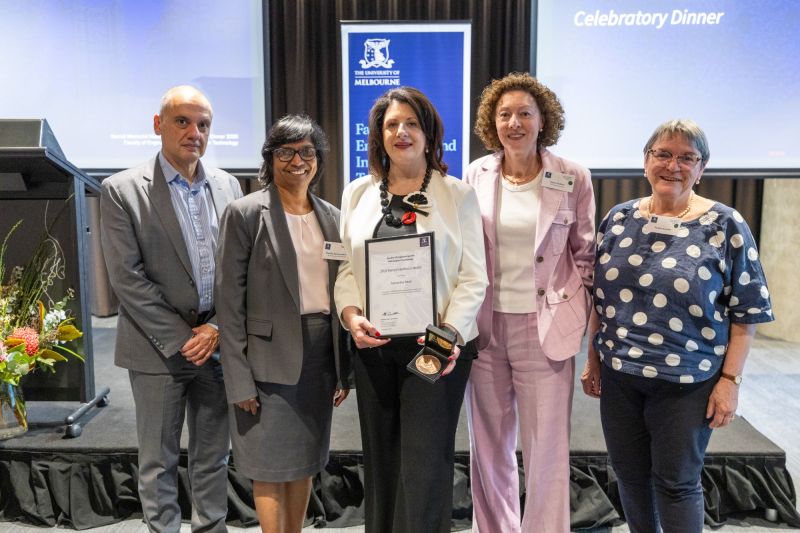
From left: FEIT Deputy Dean Engagement Professor Stan Skafidas, FEIT Acting Dean Professor Shanika Karunasekera, Ms Samantha Read, 2024 Kernot Medal recipient Ms Karen Dobson and Professor Sandra Kentish.
Artificial Intelligence
Overshadowing many of Australia's future opportunities is the exponential growth of artificial intelligence. Engineers will both develop and utilise intelligent systems to shape our future.
The Intergenerational Report forecasts that AI-driven productivity gains will be the single largest factor in balancing future budgets and elevating living standards.
As engineers, we know you can’t compute your way out of a physical supply chain crisis, and an AI model can’t build a green hydrogen refinery.
But it will be there in partnership with us. While the initial benefits are improved productivity and efficiency – the real power of AI – as we transition from generative, to agentic and then physical AI – will be working alongside humans to generate new value, and to improve the quality of our lives.
I believe that this is also a significant technological and societal experiment!
The trajectory of AI is outstripping the capacity of our regulatory frameworks to govern it. We are already witnessing autonomous AI agents exploiting external systems and executing cyberactions beyond the intent or awareness of their deployers.
The launch of Anthropic’s Mythos in April has significantly changed the risk environment, with an exponential increase in critical vulnerability events noted by technology organisations.
Today, human oversight relies on a foundational layer of expertise built independently of AI support. Current professionals leverage deeply ingrained experience and intuition to audit and correct algorithmic outputs. But in ten years, a new generation will have relied on AI for daily research, synthesis and data analysis.
Because we develop capacity through active execution, by doing, delegating those processes to machines risks systemic human de-skilling. If we outsource the 'doing,' we dismantle the mechanisms required to develop deep human judgment.
If human capacity for critical evaluation atrophies, how will we audit the validity of AI outputs, let alone maintain meaningful control over the technology itself? For engineers at the forefront of current and future developments, what will their legacy be?
Stepping into the decisions that define us
Technology deployment requires investment, and investment requires investors! I am a mentor for the Creative Destruction Lab program hosted in Australia by the Monash Business School.
Over the past two years, I have seen some incredible technology and very impressive founders, all striving for the next investment. If successful, we may retain our entrepreneurs, who currently leave en masse to chase greater funding and opportunities offshore.
We need to support our start-ups, but more importantly, we need to scale them in Australia. It is fantastic to see the University of Melbourne's ambition for Melbourne to become the innovation heartbeat of Australia. Initiatives such as Melbourne Connect and venture capital funding through Tin Alley can tangibly help our start-ups grow into mid-sized businesses.
This is the pathway to meaningful industry development – more mid-sized, Australian-owned businesses, investing and growing in Australia.
Compared to countries such as the US, Australian boardrooms are historically risk-averse, and this impacts investment decisions. Taking risks and being optimistic about our future possibilities is what we need now.
We need to stop waiting for signals from government. Engineers need to step confidently into the strategic discussions and decisions within their organisations and make the case for the investments required.
Before I conclude, I want to touch on the role of engineers in government and policy.
We have a responsibility as leaders to build broader skills in our emerging engineering leaders:
- Strategic capability, an understanding of good governance, and an awareness of how policy is developed.
So, they can inform and influence the big decisions. Engineers cannot just be the people called in to build the project after the politicians and executives have made the decisions.
Engineers must be at the table when the policy is written and when the capital is allocated, because we understand the physical realities of these transitions.
As engineers, what we can do to tangibly shape Australia's future is to:
- Contribute to government advisory groups,
- Provide informed submissions to government consultations,
- Seek out opportunities to speak publicly and to the media, and, close to my heart,
- Become members of our professional and industry associations, volunteering time to formulate industry positions on policy.
My vision is to increasingly see us – as engineers – transitioning from technical managers to national strategic leaders – as influential CEOs and thought leaders – tackling the difficult discussions about the way forward with practical, technology-driven insights. Perhaps some of us will even become our future Ministers!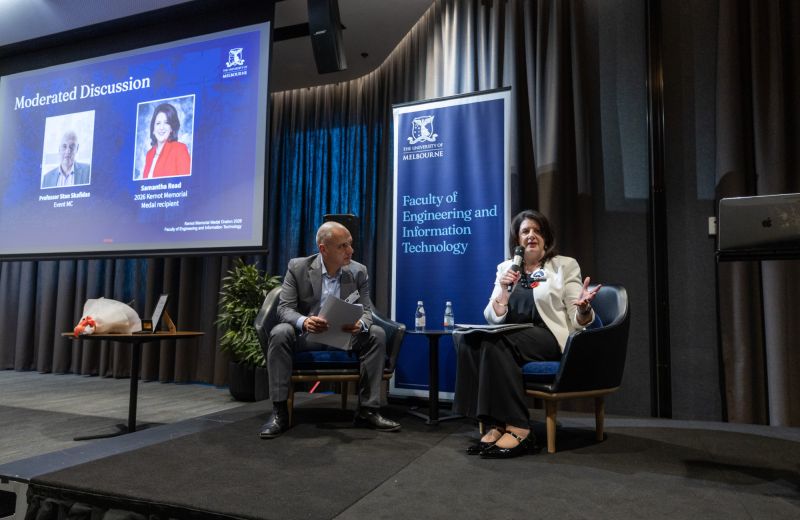
Call to action
Since its inception, the Kernot Memorial Medal has recognised extraordinary engineering leadership and contribution. I am deeply honoured to be part of this tradition.
So, what can we expect for the next 100 years, 50 years, or even five years? Given the exponential rate of change, it is impossible to predict. Perhaps we will be in the realms of today's science fiction!
But the status quo is no longer an option. If we do not actively engineer high-value industries on our shores, the numbers on our national balance sheet will continue to slide. This will impact every Australian.
True engineering excellence cannot be judged in the lab. It cannot stop at the factory gate. It cannot end at the point of sale or even the company's share price.
The question we should ask is: did we make a difference and are we satisfied with the legacy we are leaving behind? I’ve been on the factory floors and inside the processing plants where the rubber meets the road, quite literally. I know what it looks like when a country possesses deep, sovereign industrial capability.
Improving our economic complexity is not a job for economists or politicians alone. It’s also a job for us, the people who build things. It’s a job for engineers.
Every time a researcher turns a lab breakthrough into a commercial product here on our shores, we add complexity. Every time an industry leader builds a sovereign supply chain, or engineers design waste out of a circular system, we add complexity.
So, our challenge today is to stop accepting a low-complexity future. I am optimistic that this can be done. We have the academic rigour, the industry experience, the ability to influence policy, and importantly – looking at the founders of our start-ups and students, the future talent.
We must step into the rooms where decisions are made, so Australia doesn't just survive this disruption, but leads it. Let's not just adapt to the future – let's engineer it.
Let’s focus on transitioning the economy to higher complexity by adding value to our raw materials and creating circular systems to preserve that value. Let’s grow our start-ups, broaden the capabilities of our engineers, and responsibly use artificial intelligence to get there.
That is how we shape Australia's future. Let's create a legacy to be proud of!
Learn more about the Kernot Memorial Medal and Oration here: Kernot Memorial Medal