SpoTLLight: Creating Indigenous culturally inclusive learning environments
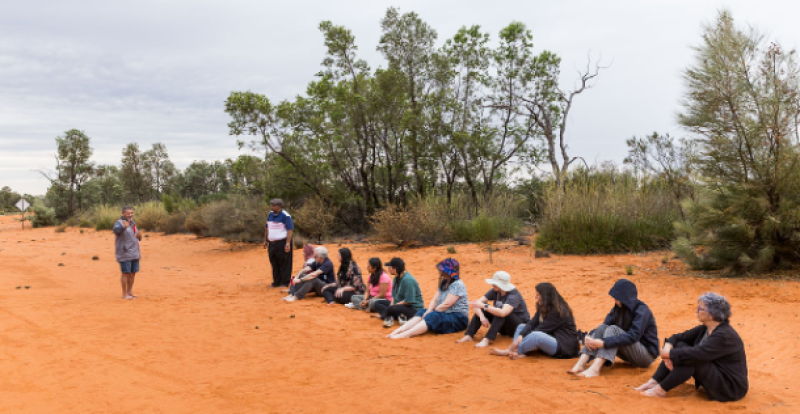
In 2024, Dr Arzoo Atiq and her team won an LTI grant for “Creating a Culturally Inclusive Environment: Enhancing Indigenous Engagement in CIS Education”. One component of this was a pilot study which aimed to educate academics on Indigenous pedagogy by immersing them in indigenous culture and communities. The overall objective of the project is to help facilitate collaborative curriculum review with experienced educators and indigenous elders to integrate Indigenous pedagogy and knowledges into CIS curriculum.
We spoke with Arzoo and the project team which includes Dr Winn Chow, A/Prof Antonette Mendoza, Prof. Shanton Chang, and A/Prof Joseph West to better understand the purpose and findings of the project.
What change do you hope to create by doing this project?
By undertaking this project, we hope to create a deep and lasting shift in how Indigenous cultures are embedded within CIS and the wider University of Melbourne. We want Indigenous students to see their cultures, knowledge systems, and ways of learning meaningfully reflected in the STEM curriculum, so that CIS is not simply a place where they are represented, but a place where they feel genuinely at home.
To achieve this, we are committed to moving away from purely Western educational frameworks towards an authentic embrace of Indigenous pedagogy and community. That means shifting from one-off events and symbolic gestures to sustained, immersive, and reciprocal engagement—such as on Country learning experiences that enable staff to connect with Indigenous knowledge in lived, experiential ways. It also means building staff capability through ongoing mentoring, shared practice, and long-term partnerships with Indigenous schools and communities.
What was involved in organising the on-country experience and preparing staff to go?
Working with A/Prof West, Faculty Indigenous professional staff, and CIS colleagues, we co-led the design and delivery of STEM on Barwon—an eight-day immersive program in Bourke and Brewarrina (NSW). The program involved 10 academics and 3 professional staff, and engaged 16 Indigenous secondary students, along with principals, teachers, and Elders across two remote schools. It combined hands-on STEM learning with a two-day on-Country experience guided by Elders, creating a powerful, culturally grounded learning environment.
With strong Faculty backing, a successful LTI grant, and a highly committed team, the program was co-developed through sustained engagement with school leaders and local communities in Bourke and Brewarrina. Dr Arzoo and Dr Winn led the discipline-focused content design with a cross-functional team of academic and professional staff, ensuring a curriculum that was both academically rigorous and culturally responsive.
How has your on-country experience improved your understanding of a culturally inclusive learning environment?
The country experience opened our eyes to a fundamentally different way of understanding the land and connecting with its people, something that is deeply experiential and very hard to simply teach in a classroom. We concluded that a truly inclusive learning environment cannot just be a policy; it has to begin with connection.
Before even touching a curriculum, what is the most critical work academics need to do to build a genuine, respectful relationship with Indigenous partners?
Indigenous knowledge, culture, identity, and authority are inseparable from land and place. Academics must approach this work with deep humility and a commitment to listening and learning, acknowledging that expertise in our own disciplines does not equate to understanding Indigenous knowledge systems. This involves engaging seriously with Indigenous scholarship and, more importantly, listening to community voices, being open to unlearning assumptions, and accepting that cultural understanding is an ongoing journey, not a box to tick.
Equally critical is allowing Indigenous partners to lead the direction of the work and ensuring it delivers meaningful, reciprocal benefit for community. Rather than arriving with pre-packaged solutions, academics need to ask, “What do you want to stay behind when we leave?” and be willing to change or abandon initial plans in response to what communities value. Trust is built through sustained relationship-building, shared spaces for dialogue and mutual learning, and co-creating initiatives with Indigenous partners so that the work is guided by their priorities, knowledge systems, and ways of doing.
What are the next steps for your project?
A central priority is sustaining relationships with Elders, schools, and communities. This work must remain ongoing and reciprocal, not a one off initiative, supported through continued program delivery each year and alignment with Faculty and University Indigenous engagement efforts.
Building on this foundation, the next phase focuses on embedding and scaling the work within CIS. We plan to engage academics, work closely with Indigenous partners, and begin with a small number of subjects to co-design and meaningfully integrate these learnings into curriculum. In parallel, we plan to establish structures to extend reach across CIS through a community of practice, enabling ongoing mentoring, shared learning, and reflective dialogue through activities such as invited talks, reading groups, and collaborative curriculum design.