Sustainability
Our Ethos
At the MCFP, we promote and support laboratory practices and research programs aligned with the University of Melbourne's Sustainability Framework and SP2030, and the UN Sustainable Development Goals. The direct operational actions we take now, guided by a Sustainability mindset, will allow us to meet our needs today while ensuring we can meet the needs of the future.
What sustainable actions are we taking?
-
Advocating for turning off equipment when not in use; always switching off monitors at the end of the day; lowering the sashes on fumehoods when not in use; changing the set temperature of ultra-low temp (ULT) freezers from -80oC to -70oC. All strategies save energy and in the case of the ULT can save up to 40%.
-
Worked with administration to have fair trade and/or rainforest alliance tea, coffee, and sugar in the department tearoom; promoting the “Green Caffeen” reusable cups (found at many cafes on campus); initiated discussions about having a food waste bin in the tearoom and a collection point for ice packs in our building that can then be reused by researchers or donated to external businesses via Pack share.
-
Promoting ride to work: Darryl encouraged the team to attend the ride to work event, provided data on the bike infrastructure on campus (repair points, bike cages and hubs, change rooms and showers). As a result, the MCFP team members that worked in Parkville campus in 2023, used in 95% of cases public transport/cycled/walked to commute to work.
How are we supporting sustainability efforts?
-
To mark 10 years of enabling research at the University of Melbourne, the Materials Characterisation and Fabrication Platform (MCFP) created a new initiative, the MCFP Sustainability Research Grants.
The grants were created to provide much needed seed-funding for projects that address critical issues related to environmental conservation, renewable energy, climate change mitigation, sustainable development, etc. You can read more about the 2024 outcomes below.
-
Concrete contributes enormously to the carbon footprint of the building and construction sectors. Our capabilities are enabling researchers to develop more sustainable concretes, through the incorporation of recycled materials, and test their properties against conventional concretes.
-
Our researchers leverage the breadth of the MCFP capabilities to develop and study novel materials for the capture and storage of energy. From light-harvesting nanomaterials, to flexible energy-generation textiles, and ultra-efficient batteries.
-
Membrane technologies play a large role in the separation of gases and liquids from one another in waste and other streams. Our researchers use the high resolution and sensitivity of our capabilities to look at the internal structure of these membranes and how nanoscale variation improve their performance.
-
Ensuring food security into the future is of significant importance in our world of ever-growing population density. We are enabling researchers to develop new biofertilisers synthesised by recovering nutrients from human urine in waste streams towards sustainable and circular agriculture.
2024 MCFP Sustainability Grant Outcomes
In 2024 we invested in 9 early- mid-career researchers in the field of sustainability, awarding a total of $12,500 in critical seed-funding. These grants covered cutting-edge research on solar cells and advanced battery technologies to critical studies on the impact of pollution on insects and the Great Barrier Reef.
See the impact in these recent publications
-
mRNA delivery enabled by metal-organic nanoparticles
Y. Gu et al. with Darryl Johnson in Nature Communications
-
Tensile Control of Vibrational Strong Light-Matter Coupling with Flexible Polyester Films
G.E. Akinoglu et al. in Advanced Functional Materials
-
Adaptive Radiative Thermal Management Using Transparent, Flexible Ag Nanowire Networks
G.E. Akinoglu et al. in ACS Applied Materials and Interfaces

Meet our Sustainability Champion
Dr Darryl Johnson is our Sustainability Champion. In addition to managing the Cytometry Node of the MCFP, Darryl works extensively on sustainability initiatives within the team and beyond. He actively incorporates sustainability actions in his everyday work, inspiring others to do the same. Darryl has been part of the Faculty of Engineering and IT green impact team (The Greengineers) since 2022 and became the team lead in 2023.
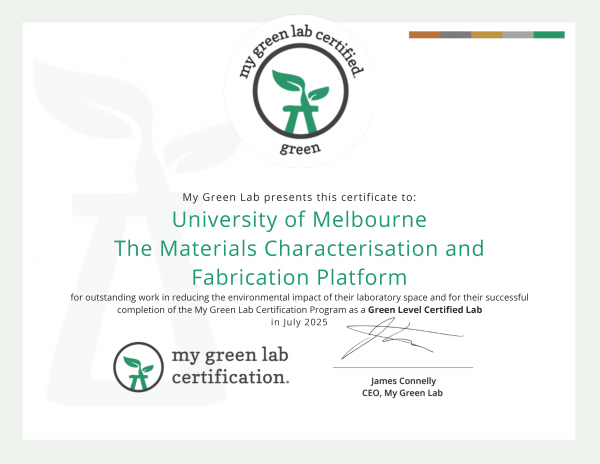
Due to his remarkable contributions championing sustainability, UoM offered him the opportunity to enrol in the ACTS (Australasian Campuses Towards Sustainability) Carbon Literacy Course, which comes with the prospect of receiving an official Carbon Literate accreditation. Additionally, Darryl has recently completed the laboratory Accredited Professional program to promote sustainability in science run by My Green Lab organisation.
Darryl channels his passion for sustainability into a mission to raise awareness and educate as many individuals as possible in the office and lab spaces. He is now part of the Australian National Fabrication Facility (ANFF) Sustainability Expert Working Group, implementing initiatives at national level.