Engineered Nanotopography to Modulate Growth and Signaling of Neuronal Networks
Hao Nguyen Tran, Kalyan Shobhana, Zlatan Trifunovic, Dan Smith, Michael Stuiber, Chennupati Jagadish, Mirella Dottori, Andrea J. O'Connor, Vini Gautam
Advanced Functional Materials (2026) https://doi.org/10.1002/adfm.77913
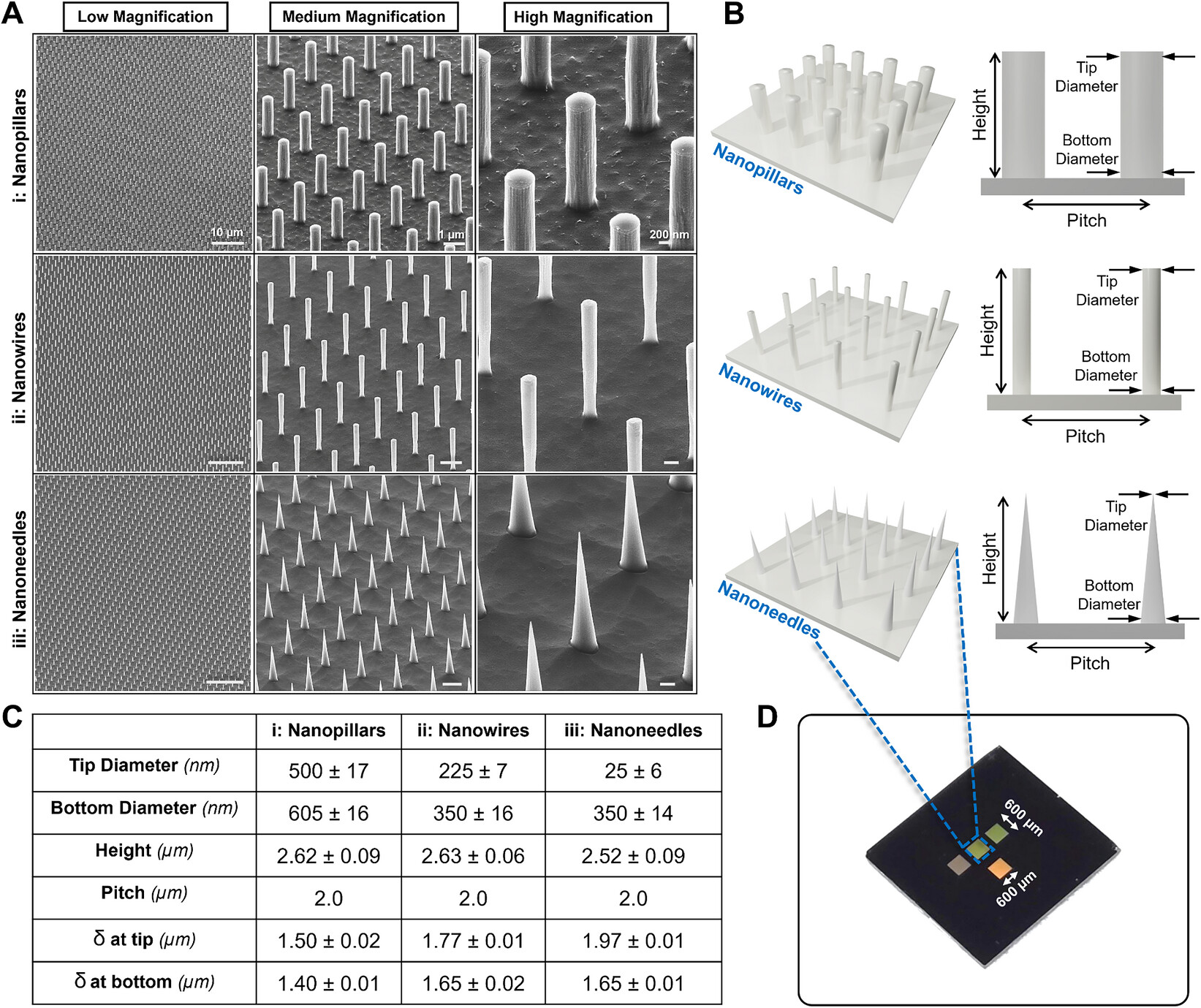
In recent years, nanostructures with varying shapes, dimensions, aspect-ratios, and spatial arrangements have been used to modulate neuronal growth and function. However, the influence of specific geometrical parameters of nanostructures on neuronal growth and signaling remains unclear. This work investigates neuronal growth and signaling in response to the geometry of nanostructures with comparable height and spatial arrangement. Specifically, arrays of isotropically arranged indium phosphide (InP) nanostructures were fabricated with a constant height (2.5 µm) and pitch (2 µm), while varying the tip and base diameters from 25 and 550 nm to yield nanoneedles, nanowires and nanopillars. All three geometries supported long-term culture of neurons, enabled directional growth of neuronal circuits and resulted in increased firing rate of neuronal signals. However, there were key differences in the degree of directionality, membrane deformation, and calcium-activity across these geometries. Despite similar dimensions and spatial arrangement, a 100 nm variation in the gap and tip-diameter of the nanostructures influenced membrane penetration, neuron pinning and neurite guidance, which in turn affected neuronal network signaling. This study holds significance in design and fabrication of appropriate nanoscale geometries for understanding and modulating spatiotemporal dynamics of the nervous system at single cell and network level.
Our expertise and capabilities in this research
-
Dan Smith
Dan leads the nanofabrication capability for the MCFP. Situated in the heart of ANFF-Vic at the Melbourne Centre for Nanofabrication (MCN), Dan has expertise across the most extensive fabrication capability in Melbourne, and can help you from design to device realisation.
-
Nanofabrication
The MCFP Nanofabrication platform supports University of Melbourne (UoM) researchers accessing the Melbourne Centre for Nanofabrication (MCN) located in Clayton
-
Helium ion microscopy and dual-beam nanofabrication
The Zeiss ORION NanoFab is an advanced scanning ion microscope that utilises an interchangeable dual-ion beam (helium and neon) for nanofabrication and sub-nanometre imaging