Molten salt-derived Co-intercalated TiS2/MXene heterostructure for boosting alkaline overall water splitting
Jianan He, Adrian Chun Minh Loy, Jining Guo, Ali Zavabeti, Dingqi Wang, Longbing Qu, Raveen Wijesuriya, Yuezhu Xiao, Jitraporn Vongsvivut, Joshua D. Butson, Qinfen Gu, Gang Kevin Li
Chemical Engineering Journal (2026) https://doi.org/10.1016/j.cej.2026.180184
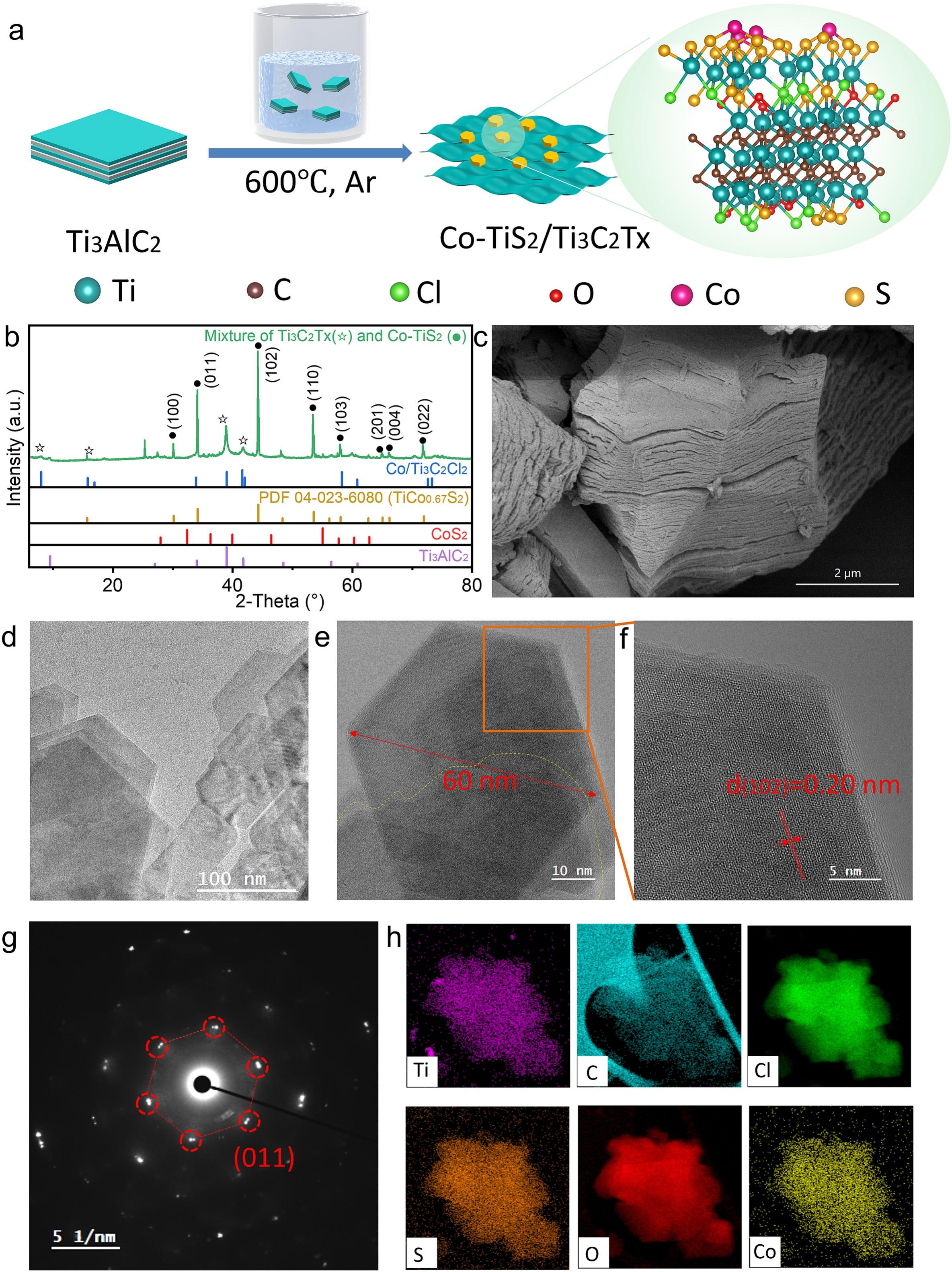
Two-dimensional MXenes have emerged as versatile platforms for electrocatalysis due to their tunable surface chemistry and layered structures. However, the intrinsic activity of MXenes is limited by their vulnerability in oxidizing and alkaline environments. Herein, we report a one-step molten-salt topochemical transformation that simultaneously tailors MXene surface terminations and constructs an in situ Co-TiS2/MXene heterointerface. This method effectively disperses hexagonal Co-TiS2 nanoparticles, increases the exposure of active sites, and prevents the oxidation and aggregation of Ti3C2Tx, significantly enhancing the overall water splitting performance. The incorporation of S promotes the transformation of the Ti3C2Tx to the Co-TiS2 derivative, modulates the electronic structure, and is predicted by DFT calculation to provide more favorable adsorption energies of reaction intermediates. Combined experimental characterization, including X-ray absorption spectroscopy, high-resolution transmission electron microscopy, and in situ synchrotron-based Fourier-transform infrared spectroscopy, together with density functional theory calculations, reveals that the MXene-derived Co-TiS2 stabilizes the Co atoms, facilitating both hydrogen and oxygen evolution reactions. Consequently, the Co-TiS2/Ti3C2Tx (Tx = S, Cl, O) catalyst exhibits enhanced bifunctional activity in 1 M KOH, with lower overpotentials and excellent stability than pristine Ti3C2Tx MXene. This study highlights the potential of surface-engineered MXenes and their derivatives for the rational design of highly efficient electrocatalysts and provides insight into the role of surface terminations in tuning structure and catalytic performance.
Our expertise and capabilities in this research
-
Raveen Wijesuriya
Raveen leads the X-ray Characterisation node of the MCFP, including X-ray diffraction (XRD) and fluorescence (XRF) and all sample preparation required including milling and pellet forming. He will guide you from start to finish of XRD analysis.
-
X-ray diffraction (XRD)
X-ray diffraction provides information on the structure of your material