1. Materials Characterisation and Fabrication Platform
  2. MCFP Learning
  3. Scanning Electron Microscopy
  4. Getting good images
  5. Choosing the detector
  • Scanning Electron Microscopy
  • Introduction
  • Applications of SEM
  • All Fundamentals of SEMThe sourceThe columnThe chamber and sample stageElectron interactions and detected signalsVacuum modes
  • All Getting good imagesSample preparationBeam conditionsChoosing the detectorFocussing and working distanceBrightness and contrastScan speedStigmatism
  • Get into the lab!

Choosing the detector

Once you have your beam conditions chosen, the next most important choice will be which signals to record. Remember that our SEM has multiple detectors available, each providing different insight into your sample surface. Not all of these detectors are available in all modes of operation of the SEM however. Let's recap the detectors available on the FlexSEM.

  • The SE detector excels at topographic imaging, highlighting the edges of topography on your sample. It is ideally suited to looking at particles and fibres, and any surface where the texture/roughness is what you are interested in. It will give the sharpest image.

    • Best used with a conductive or coated sample
    • Only available in the high-vacuum SEM mode
  • The BSE detector highlights material or compositional contrast. Regions of your sample that contain elements with greater atomic mass will appear brighter than those with lower atomic mass. These electrons come from deeper in the sample, and may give a softer image.

    • Can be used in all vacuum modes and on samples of varying conductivity
    • Metal coatings may lessen material contrast
  • The X-ray detector used in EDS/EDX analysis will tell you which elements are present and where on the sample. It is rarely used by itself, and is often coupled with the BSE detector to give more information about the observed material contrast. The resolution of EDS is never as good as SEM.

    • Can be used in all vacuum modes and on samples of varying conductivity
    • Metal coatings will appear in the EDS spectra and may overlap with elements of interest
  • The UVD enables "SE-like", i.e. topographic, imaging in the VP-SEM mode, giving back edge contrast that is otherwise not achievable with the BSE detector. It is a photon detector, so under special configuration it can also be used for cathodoluminescence (CL).

    • Topographic imaging in the VP-SEM mode
    • Cathodoluminescence (CL) imaging
    • Only available in the VP-SEM mode
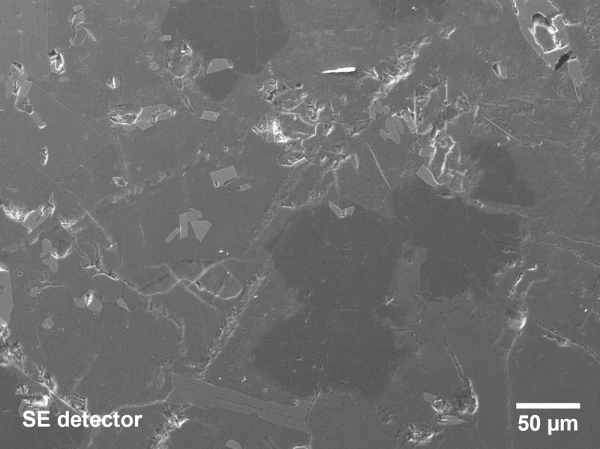
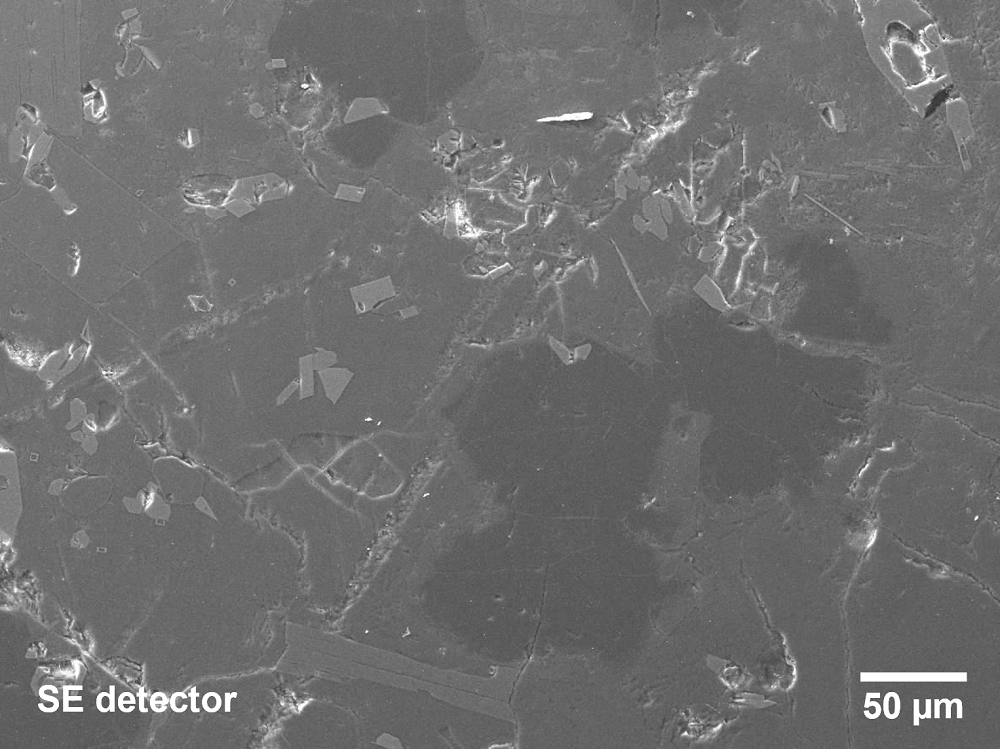
  • Mineral imaged with SE detector
    The SE detector is not the best choice of detector for a polished mineral cross-section, as it does not give sufficient contrast to the mineral grains
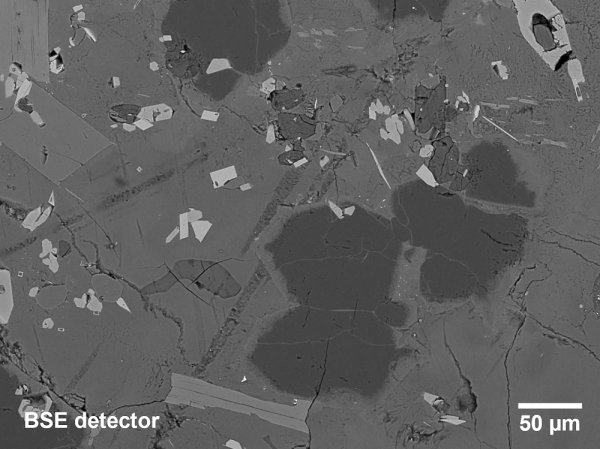
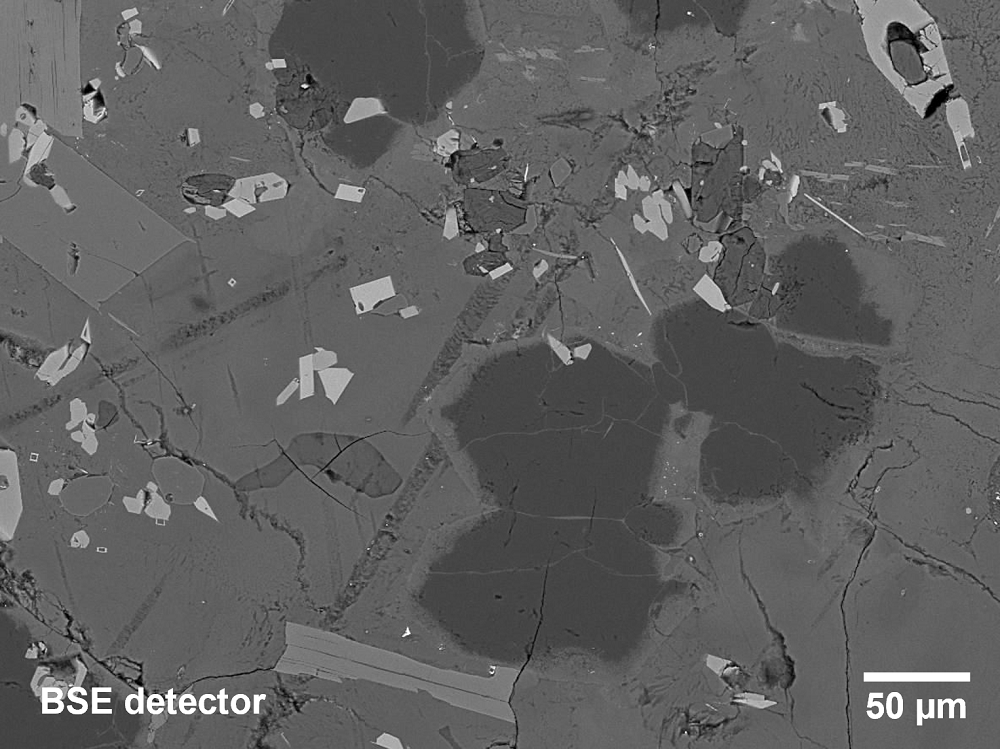
  • Mineral imaged with BSE detector
    The BSE detector is the better choice for imaging polished mineral cross-sections, as the contrast comes from the change in composition, and topography is minimal due to the polishing
Did you know?

You can capture images from two detectors simultaneously with the FlexSEM. This can be handy when you are not certain which image is going to communicate your work the most clearly. You can capture

  • SE and BSE in the high-vacuum SEM mode
  • BSE and UVD in the variable-pressure VP-SEM mode

Quick Guide to Choosing Detectors

  • Assuming this means the sample will be entirely conductive, topographic imaging with best resolution and sharpness is what you want to achieve here:

    • Choose the SE detector in the SEM mode
  • Ideally you want to maximise topographic contrast here, but will probably need to eliminate charging to make the most of your imaging:

    • Coat your sample and choose the SE detector in the SEM mode
    • Alternatively use the UVD detector in the VP-SEM mode
  • Polishing removes topography, so we want to enhance material contrast instead:

    • Choose the BSE-COMP detector
    • If your sample is conductive, or you see minimal effects of charging, use the SEM mode
    • If you have trouble with charging use the VP-SEM mode
  • Roughness is enhanced with a topographic signal like that from teh SE detector:

    • Choose the SE detector
    • Coat your sample first if it is non-conductive
    • Consider using a 45° pin stub to further enhance roughness

Next - Focussing and Working Distance

Back to MCFP Learning Home

Materials Characterisation and Fabrication Platform

  • Our Capabilities
    • Nanofabrication
    • Nanomaterials Characterisation
      • Atomic force microscopy
      • Anton Paar NHT3 Nanoindenter
      • DataPhysics optical contact angle
      • Hirox RH-2000 2D/3D microscope
      • Quorum Q150T Sputter Coater
    • Advanced Fluorescence Imaging
      • Zeiss Elyra 7 Lattice SIM
      • Nikon A1R+ Confocal Microscope (CLSM)
      • STORM (Stochastic optical reconstruction microscopy): Nikon N-STORM
      • Olympus IX71 Fluorescence Microscope
    • Cytometry and Particle Characterisation
      • Mass cytometry
      • Halo
      • NanoSight Pro
      • Apogee A-50 Microflow Cytometer
      • CytoFLEX Nano
      • Imaging Flow Cytometry
      • ICP-MS
      • Imaging ToF-ICP-MS
    • Electron and Ion Microscopy
      • Scanning electron microscopy (SEM)
      • Helium ion microscopy and dual-beam nanofabrication
      • Sample Preparation
    • X-Ray Characterisation
      • X-ray diffraction (XRD)
      • X-ray fluorescence (XRF)
    • Vibrational Spectroscopy
      • Confocal Raman Microspectroscopy
      • Fourier Transform Infrared Microscopy
    • Biological Optical Microscopy Platform (BOMP)
    • Ian Holmes Imaging Centre
    • Trace Analysis for Chemical, Earth and Environmental Sciences (TrACEES)
    • University of Melbourne Research Infrastructure
    • MCFP 2023 User Survey
  • Access Equipment
  • MCFP news and events
    • MCFP Image Competition
      • MCFP Image Competition
  • Our Expertise
    • Elena Taran
    • Anders Barlow
    • Paul Brannon
    • Darryl Johnson
    • Dan Smith
    • Raveen Wijesuriya
    • Tian Zheng
    • Ray Dagastine
    • George Franks
  • Services for Industry
  • MCFP Learning
    • Video Guides
      • LUMOS ATR-FTIR Guides
      • CytoFLEX Guides
      • NanoSight Guides
      • FlexSEM-EDS Guides
    • FlexSEM-EDS FAQs
  • Sustainability
    • Sustainability Framework
    • Sustainability on Campus
    • FEIT Sustainability
    • Green Impact
    • Sustainable ANFF
  • Publications
  • Current Students
  • Library
  • Staff

Acknowledgement of Country

We acknowledge Aboriginal and Torres Strait Islander people as the Traditional Owners of the unceded lands on which we work, learn and live. We pay respect to Elders past, present and future, and acknowledge the importance of Indigenous knowledge in the Academy.

Read about our Indigenous priorities

Site footer

  • About us
  • Careers at Melbourne
  • Safety and respect
  • Newsroom
  • Contact
  • Campus locations

Contact details

Phone 13 MELB (13 6352)
International +61 3 9035 5511

Address
The University of Melbourne
Grattan Street, Parkville
Victoria 3010
Australia

Connect with us

  • Emergency
  • Terms & privacy
  • Accessibility
  • Privacy
  • The University of Melbourne (Australian University): PRV12150
  • CRICOS number: 00116K
  • ABN: 84 002 705 224